Appendix

Methods
This report draws on multiple forms of data collected between September 2023 and September 2025, building on Beyond the Bars’ multi-year program of research and organizing among workers with records in South Florida. An overview of that data follows.
Qualitative data
Beyond the Bars collected qualitative data from 2023 to 2025, including surveys and structured, in-depth interviews with incarcerated and formerly incarcerated people, academics, reentry professionals, government officials, and temp agency administrative staff. We also engaged in field observations at temp agencies, reentry organizations, and host employers to document employment practices and working conditions.
In 2023, Beyond the Bars staff, in collaboration with 15 students at the University of Miami School of Law, conducted 183 surveys of people incarcerated in Miami-Dade County jails. The surveys were administered in person over four days (October 24, 25, 26, and 27) at the Turner Guilford Knight Correctional Center (TGK) and the Metro West Detention Center (MWDC). Beyond the Bars staff and students, working under faculty supervision, completed mandatory online training, passed criminal background checks, and were escorted by MDCR staff throughout the process.
Each survey session lasted approximately 20 to 30 minutes and was conducted in English, Spanish, or Haitian Kreyòl, with professional translation to ensure accuracy. The survey included multiple-choice and open-ended questions designed to record participants’ experiences with the financial burdens of incarceration and the employment barriers they face upon reentry into the community, as well as the potential impact of reforms to fines and fees advanced by Beyond the Bars.
In 2024, Beyond the Bars members conducted site visits to 89 temp agencies and 58 reentry and workforce organizations across South Florida. Beyond the Bars members also surveyed 80 job seekers at a reentry job fair, the majority of whom reported seeking work through temp agencies and most of whom were being paid at or below minimum wage.
In 2025, Beyond the Bars members knocked on 1,443 doors of Miami-Dade residents listed in a public database of individuals who had been arrested. These outreach efforts led to 608 in-depth conversations, in which 348 people reported having an incarcerated loved one and 260 reported having a criminal record themselves. In addition, we conducted nine in-depth interviews with temp workers with records who are members of Beyond the Bars. All quotes drawn from these interviews have been anonymized to protect participants’ identities.
In addition in 2025, Beyond the Bars members conducted 55 structured site surveys at temp agencies to document working conditions and agency practices. Each survey recorded data on the physical environment and labor practices at these sites, including: hours of operation; transportation and parking arrangements; access to bathrooms, drinking water, and seating; and the presence of shade, shelter, or security.
Members also recorded whether workers were provided health and safety information, whether wage and rights posters were displayed, and whether workers were charged for required equipment or transportation to job sites. The surveys collected qualitative observations on worker safety, respect, and interaction, as well as quantitative estimates of worker volume, job availability, and typical wait times. Where possible, members gathered supporting materials such as photographs, pay stubs, and contracts to corroborate findings.
These conversations informed both the qualitative analysis in this report and Beyond the Bars’ broader organizing agenda, shaping strategies to expand worker power through leadership development, public policy advocacy, and strategic corporate campaigns.
Quantitative data
Quantitative data on the number of temp workers by industry comes from the U.S. Bureau of Labor Statistics’ (BLS) Occupational Employment and Wage Statistics (OEWS) Research Estimates by State and Industry for May 2024, the most recent year of this annual release. Estimates of the total number of temp workers, as well as their share of the overall workforce, are drawn from the BLS Current Employment Statistics (CES) and are current through May 2025. County-level data was drawn from the U.S. Census Bureau’s County Business Patterns survey.
Because temp work is highly transitory, these federal datasets provide only a moment-in-time snapshot of the workforce. However, the nature of the work means that many more workers spend at least some time as temps over the course of a year. To estimate the total number of people who work in temp positions over the course of a year, we relied on data from the ASA, which compiles data from surveys of its members, which are temp agencies. We were careful not to compare data points across sources.
Data on workplace safety was obtained from OSHA’s Establishment Search tool, and data on wage and hour violations was gathered from the U.S. Department of Labor’s (DOL) Enforcement Data. Both datasets were current through September 23, 2025.
Literature Review
To supplement our direct experience and prior research into the industry, we conducted an extensive literature review on the temp industry, employment opportunities upon reentry, and contingent work more broadly:
- Several reports from the National Employment Law Project were especially helpful in understanding the structural drivers that have encouraged the use of temp workers including Laura Padin’s “Eliminating Structural Drivers of Temping Out: Reforming Laws and Programs to Cultivate Stable and Secure Jobs,” and Han Lu’s “Worker Power in the Carceral State.”
- Emine Fidan Elcioglu’s “Producing Precarity: The Temporary Staffing Agency in the Labor Market” provided a valuable case study revealing how the structural relationship between the carceral state, the reentry ecosystem, and temp agencies functions in practice.
- Jane Flanagan’s “Fissured Opportunity: How Staffing Agencies Stifle Labor Market Competition and Keep Workers ‘Temp,’” contains one of the most detailed published accounts of how temp agency contracts work.
- George Gonos’s research, including “The Contest Over ‘Employer’ Status in the Postwar United States: The Case of Temporary Help Firms,” “Taming the Employment Sharks: The Case for Regulating Profit-Driven Labor Market Intermediaries in High Mobility Labor Markets,” and a follow-up interview with Gonos, was essential for understanding the temp industry.
- Noah Zatz’s work, including the articles “The Carceral Labor Continuum” and “Get To Work or Go To Jail,” articulate how carceral power extends into “free” labor markets, linking prison labor, work-release, and probationary employment within a single system of labor control.
We are grateful to these authors, and the others referenced in this report, for their work on this topic.
Limitations
While the findings reflect extensive field and desk research, limitations include incomplete data from temp agencies and the challenges of reaching workers in transient employment situations. The diversity of qualitative and quantitative sources reflects how difficult it is to fully capture the size and nature of the contingent workforce, particularly for populations affected by incarceration. Existing federal estimates likely undercount temp workers, and health and safety data often only attribute incidents to the host employer, not the temp agency. Additionally, the precarious nature of temp work and the fear of retaliation contribute to significant underreporting of wage theft and workplace injuries.
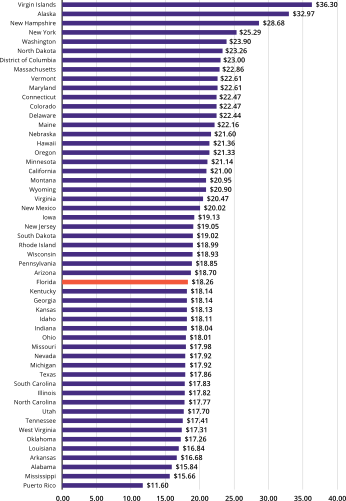
Hourly Median Wage for Temp Workers by State171
Staffing Industry Analysts’ Top 20 Industrial Temp Agencies with Data on Florida Branches172
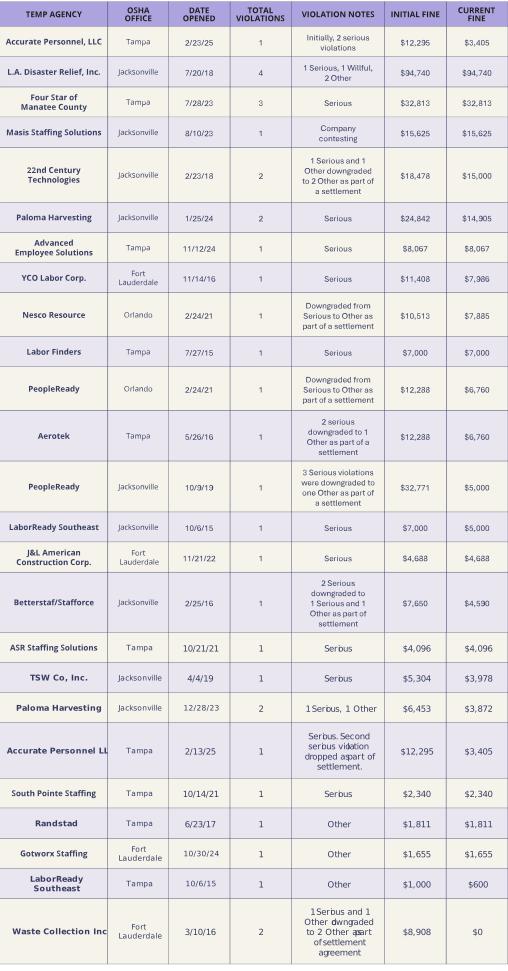
OSHA Citations at Florida Temp Agencies since 2015173
Footnotes
- BLS, Occupational Employment and Wage Statistics, OEWS Research Estimates by State and Industry, May 2024, https://www.bls.gov/oes/current/oes_research_estimates.htm.
- Staffing Industry Analysts, Largest Industrial Staffing Firms in the U.S.: 2022 Update, https://www.apstemps.com/wp-content/uploads/2022/12/Largest-Industrial-Staffing-Firms-in-the-US-2022.pdf. Additional research on brands and locations by the authors.
- OSHA, Inspections Within Industry (data current through September 23, 2025), https://www.osha.gov/ords/imis/industry.html, for NAICS Code 561320 within the state of Florida.
Want future reports + tools?
Subscribe to The Work Release to get new publications, campaign updates, and worker stories.