Part 1: The Carceral Roots of Precarity

As an organization dedicated to building the power of workers with records, Beyond the Bars didn’t necessarily choose to focus on temp agencies. They chose us.
When we set out to understand the post-incarceration labor market, we built on what our members and staff had already shared anecdotally; story after story of people turning to temp agencies after getting out of jail. Many told us they first tried to return to their old jobs or find work in familiar industries, only to be turned away once an employer ran a background check. After facing rejection time and again in the traditional job market, they often turned to temp agencies that they’d heard about through referrals or word of mouth as employers who would be willing to hire them, no questions asked.
One Beyond the Bars member, Felix, said, “Before I went to jail, I was a manager at Office Depot. When I came out, I couldn’t get the kind of jobs I had before. Probation required a paycheck, and I had court fees due. With better jobs closed off because of my record, I ended up at labor pools—doing construction, which I’d never done before.” Felix’s story reflects a broader reality: Many people returning from incarceration bring valuable skills and prior work experience from a wide range of occupations, yet those skills are often ignored or underutilized by the industrial temp agencies that funnel them into low-wage, manual labor.
Our research confirmed what our members told us. Temp agencies aren’t a choice; they’re practically the only option. Even before a person leaves prison or jail, they are often handed a list of temp agencies to contact upon release. Felix, quoted above, recalled receiving a packet of information that included the names of several temp agencies before he was even released. On its face, giving someone a head start on finding employment seems like a good thing, but it wasn’t that simple. “When I got out, my first thought was, I’m going to use what they gave me,” he said. “That’s the first place you go, but when you get there, they’re not really helping anybody.”
State supervision officers, such as probation officers, also push temp agencies as a main option, often providing lists of agencies they know hire people with records. As a condition of supervision, individuals must secure and maintain employment while also paying off court fines, supervision fees, and restitution. In essence, they are forced to accept virtually any job—no matter how exploitative—in order to stay free.
“You need a temp agency because some jobs won’t hire you,” Michael, a Beyond the Bars member, said during an interview. “That’s why I say temp agencies are very important to people with records, because they allow you to come to the establishment, and they give you an opportunity. If people don’t give you the opportunity, how are you going to go any further?”
An October 2023 survey conducted by Beyond the Bars and University of Miami law students inside two Miami-Dade jails found that 52.7% of respondents had been denied employment because of a criminal record.33 Respondents also cited other barriers: lack of transportation or ID, language access, immigration status, limited education or training, and jobs that paid too little to meet basic needs.
Beyond the Bars members report that temp agencies in Florida routinely conduct I-9 verification to comply with state law, which since 2023 has required nearly all private employers with 25 or more employees to use the federal E-Verify system to confirm work eligibility.34 E-Verify, operated by the U.S. Department of Homeland Security (DHS), cross-checks information from workers’ I-9 forms against federal databases. Under Florida’s updated law, employers who fail to comply face fines of up to $1,000 per day, and the state can also suspend business licenses for repeated violations.
Unlike in many northern states, where temp agencies often hire undocumented workers, labor pools in Florida rarely do so. Undocumented workers report that it has become increasingly difficult to find employment—even through temp agencies that were once reliable sources of work—under the new federal administration. In Florida, immigration enforcement has intensified with the strong support of state and municipal governments through 287(g) agreements,35 making the state a national epicenter of ICE raids. In response, temp agencies in Florida are now actively marketing themselves as providers of I-9-verified workers.
Rick Hermanns, CEO of HireQuest, a national temp agency that places workers in industries such as roofing and construction, told Roofing Contractor that the heightened immigration crackdown has left many contractors struggling to find labor. His company, which employed about 60,000 workers last year, now advertises that it supplies fully vetted, I-9-verified workers for short-term or on-demand assignments.
“If you’re a company and you need ten people to load trucks, you literally can call us that morning,” Hermanns said. “Have ten people there to unload the truck and they’re done at the end of the day.”36
Florida does not have a statewide “Ban the Box” law to prohibit private-sector employers from asking about previous convictions. (State law does specify that “a person may not be disqualified from employment by the state, any of its agencies or political subdivisions, or any municipality solely because of a prior conviction for a crime” (emphasis ours), unless the crime is directly related to the position being sought.37 Even when an employer might otherwise be willing to hire someone with a record, other barriers often intervene; insurance restrictions and fear of negligent hiring liability make employers view hiring these workers as risky. Combined with gaps in work history and limited access to training, these barriers effectively prevent people with records from entering into stable careers.
Temp agencies step into this vacuum, offering a legal workaround. They hire workers with records directly and then place them at job sites where those same workers would have been screened out by background checks. For blue-collar positions, temp agencies typically skip background checks, allowing host employers to benefit from the labor of people with records without assuming legal liability as the employer of record or responsibility for providing benefits or fair wages.
This dynamic is captured in the story of Ricky, a Beyond the Bars member who applied for a job at Coca-Cola paying $21 an hour with benefits, but was denied after the company ran a background check. Weeks later, he was hired through a temp agency in Broward County, to do the exact same work—at the same company, in the same shop—for just $12 an hour, without benefits. His experience illustrates how temp agencies serve as intermediaries that enable major employers to profit from the labor of people with records while keeping them on the margins of the formal workforce.
To understand how this system operates, Beyond the Bars members visited 89 temp agencies and 58 reentry and workforce organizations, interviewed 608 Miami-Dade County residents who either had a record or an incarcerated family member, and conducted nine in-depth interviews with temp workers. This field work revealed a clear pattern: Most people with records find work in construction (usually demolition or general labor) or warehousing.
Federal employment data confirmed what our field work identified: The industries where people with records most often find work are the same ones where temp work is most deeply entrenched. Statewide, 1.7% of all Florida workers are employed through temp agencies, but the share is far higher in entry-level occupations in construction, warehousing, and manufacturing: 8.7%, 11.7%, and 17.3% respectively.38
Figure 2: Percentage of Temp Workers, Selected Detailed Occupations in Florida39

The scale of these industries helps explain the temp sector’s outsized influence in Florida’s economy. In 2024, construction ($58.84 billion), warehousing ($45.21 billion), and manufacturing ($62.64 billion) together generated $166.69 billion in real value added—roughly 13% of Florida’s total $1.27 trillion GDP.42 These are also the industries with the highest concentrations of temp workers, meaning that Florida’s economic growth quite literally depends on the labor of people placed through temp agencies, many of whom are workers with records.
This data underscores what our field work made clear: the blue-collar temp industry is one of the engines of Florida’s economy.
And yet: This economic engine is built on poverty wages.43
Figure 3 shows the scale of this dependence. As explained above, temp workers make up a critical share of Florida’s blue-collar workforce, especially in construction and warehousing. Those occupations are represented on the left side of Figure 3, where wages are lowest. Across all occupational groups, wages for temp workers remain substandard, but they are lowest in the industries to which workers with records are most often steered by temp agencies.
Figure 3: Number of Temp Workers and Median Wages, All Occupations in Florida With 5,000 or More Temp Workers Plus Selected Other Occupations46

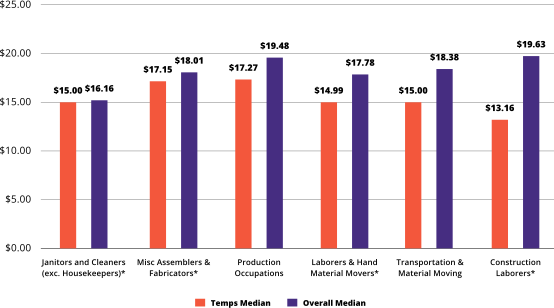
In 2024, temp construction workers earned a median wage of $13.16 per hour, while temp warehouse workers earned $14.99 per hour,44 barely above the state minimum wage and far below the living wage for a single adult in Miami-Dade County, approximately $23.50 per hour that year.45 For most temp workers with records who are parents or caregivers, sustaining a household would require wages two to three times higher than what they currently earn. Earning a living wage is also key to helping people avoid the economic instability that often leads to reincarceration. Figure 4 shows how much these temp workers lose compared to directly hired employees in key blue-collar industries. In all of these occupations, temp workers earn less than the median wage for all workers in Florida in that same job category.47 The gap is especially pronounced in entry-level construction and warehousing occupations, the sectors most accessible to workers with records. Temp construction workers earn about $6.47 less per hour, and temp warehouse workers about $3.38 less, equivalent to $13,458 and $7,030 in lost income per year, respectively.
Figure 4: Median Wage, Temp Workers vs. All Workers in Florida, Selected Occupations48
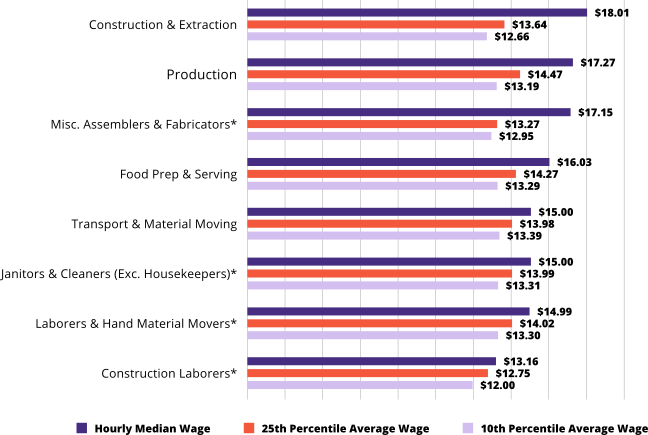
Median wages, such as those shown in Figures 3 and 4, however, likely overstate what temp workers with records actually earn. People with records are more likely to hold lower-paying, entry-level positions49, a pattern reflected in both existing research and our interviews with Beyond the Bars members. Figure 5 examines wages at the 10th and 25th percentiles, which better capture entry-level earnings in these occupations.
Among construction laborers, for example, the gap between the 10th percentile and the median wage is $1.16 per hour—equivalent to about $2,400 less per year than the median temp construction laborer, and $15,858 less than the average for all construction laborers. For entry-level warehouse jobs, the gap is even wider: $1.69 per hour, or roughly $3,500 less annually than the median temp warehouse worker and $10,530 less than for all warehouse workers.
Figure 5: Temp Worker Wages in Florida at the 10th Percentile, 25th Percentile, and Median, Selected Industries50
The lost yearly income estimated for each occupation above, which is already astronomical, likely significantly overstates what temp workers actually take home. Incomes in these occupations are typically irregular and unsteady, as temps work fewer hours and fewer full weeks per year, which substantially reduces their total annual earnings. These wages are further eroded by how many temp agencies pay: Many workers do not have bank accounts and therefore can’t receive direct-deposit payments, and instead are paid via fee-laden debit-release cards or paper checks that require time-consuming and costly check-cashing transactions. In other words, workers lose a portion of their already low wages simply to access their own pay.
For workers already living paycheck to paycheck, these margins are devastating. For formerly incarcerated people who return to their communities with thousands of dollars in court fines and fees, along with lost income from incarceration51 and the ongoing costs of rent, childcare, and food, these financial gaps can be insurmountable.
Together, these figures paint a clear picture: Florida’s economy depends on systematically undervaluing the very workers who sustain it.
In 2024, Florida ranked 31st in the nation for median hourly wages among temp workers. (See Appendix.) But if we look at typical wages for temp workers at the 25th percentile, which more closely approximates the types of entry-level positions likely to be available to workers with records, Florida ranked 43rd in the country.52
No one wants to earn poverty wages. Workers with records turn to temp agencies not because the jobs they offer will pay the bills, but because they are among the few options available to them after incarceration.
To understand this dynamic, we must look to the carceral systems and parallel industries that continue to govern workers’ lives after release. The following sections examine how Florida’s supervision system and reentry infrastructure extend carceral control, shaping when, where, and how people with records are allowed to work.
The Economy of State Supervision
The challenges that workers with records experience in finding a job can only be understood in the context of their arrest, incarceration, and subsequent release.
Roughly 70 percent of people incarcerated in Florida’s county jails are awaiting trial.53 Many are released pre-trial on house arrest by county courts (for misdemeanor charges) or circuit courts (for felonies) under the supervision of the county jail administration. (In all Florida counties except Miami-Dade, this function is handled by the sheriff’s office.)
Because court cases are often delayed, people can spend months—or even years—under house arrest, living with highly restrictive conditions of release; for example, being under “total lockdown,” meaning they are prohibited from leaving their homes entirely except for court appearances, medical emergencies, or, in some cases, work.54
Between 2009 and 2013, about 72 percent of state criminal cases filed in Florida courts (including felony, misdemeanor, and criminal traffic charges) resulted in a conviction,55 almost always through plea agreements rather than trials; in 2024, 1 percent of convictions in Florida were decided by a jury.56,57 After conviction, individuals may be released with credit for time served between the time they were arrested and the resolution of their case; they might serve their sentences in county jail or state prison; or they might be placed on a form of state supervision through the Florida Department of Corrections (FDC), typically either on probation or on community control.
Those sentenced to state prison must serve 85 to 100 percent of their sentence under Florida’s “Truth in Sentencing” law, the Stop Turning Out Prisoners (S.T.O.P.) Act.58 During that time, almost every incarcerated person is required to work; those who refuse can be denied access to basic privileges, like visitors, recreation, or even placed in solitary confinement. Under the exception clause of the Thirteenth Amendment to the U.S. Constitution, which permits forced labor “as punishment for a crime”,59 incarcerated people can be legally compelled to work. They are also excluded from basic labor and employment protections, including the right to a union,60 minimum-wage guarantees,61 and workplace-safety laws.62
As a result, nearly every incarcerated person in the US performs unpaid or extremely low-wage labor across three categories:
- Private sector: A small portion (roughly 5,000 incarcerated workers nationally) are employed by private corporations through the federal Prison Industry Enhancement Certification Program (PIECP), which allows companies to access incarcerated labor to manufacture goods.63 Participating corporations have included Avery Dennison and Burlington Industries. Although PIECP is one of the only programs that pays so-called “prevailing wages,” deductions are so steep that workers often take home only a few dollars per day.
- Correctional industries: Approximately 67,000 incarcerated people work for government-run correctional industries, providing services such as answering phones in call centers, conducting asbestos abatement, and grave digging, as well as manufacturing school furniture, street signs, and even military equipment used by government agencies.64 In Florida, this work is carried out through Prison Rehabilitative Industries and Diversified (PRIDE) Enterprises, Inc. Wages in these programs are extraordinarily low; in Florida, they range from 20 cents to 95 cents an hour.65
- Facility and system support: The vast majority work to sustain the operation and upkeep of the facilities where they are incarcerated, preparing food, delivering commissary, doing laundry, cleaning units, performing maintenance, serving as clerks, and more.66 These roles are typically compensated at nothing to just pennies per hour; in Florida, they are entirely unpaid.
In total, incarcerated people who work in the U.S. are cheated out of an estimated $18 billion in wages every year.67 This structure not only results in systematic wage theft but also conditions incarcerated people to accept dangerous and degrading working conditions, without meaningful recourse or knowledge of labor rights—rights that are nearly nonexistent in practice behind bars.
Some incarcerated people are moved into work camps when they are within 18 months of their release date, in which they remain incarcerated but are sent out during the day to work for private employers. Most earn little more than minimum wage, and their after-tax pay is heavily garnished by FDC: 45 percent for room and board, 10 percent for restitution or court-ordered payments, and another 10 percent for family assistance or child support. (“Participants are also required to save 10 percent of their net pay.”)68 These programs show how Florida’s carceral system uses incarcerated people’s work to sustain itself financially, keeping punishment and revenue tightly linked.
Once released from prison, people may technically be “free,” though typically burdened with tens of thousands of dollars in fines and fees owed to courts, lawyers, jails, and prisons. Increasingly, however, they also remain under state supervision. About 36 percent of people leaving Florida prisons transition to some form of post-release supervision, such as conditional release, probation, or community control, administered by FDC.69
Under state law, supervision can legally continue for up to the maximum term of the original sentence. In Florida, people remain under state control for an average of three to fifteen years,70 and, in some cases, for the rest of their lives.
People under FDC supervision must comply with an extensive set of rules and restrictions. Standard conditions include daily curfews, in-person check-ins with supervision officers during business hours, maintaining employment, and prohibitions on changing residence or employment without prior approval. People under supervision are also barred from traveling outside their county without consent from the court or supervision officer, are subject to random drug tests and warrantless home searches, are required to pay monthly supervision fees, and are prohibited from associating with other people with felony convictions.
This severely limits social and community ties, particularly in neighborhoods where incarceration and supervision are widespread. Judges frequently add additional conditions such as mandatory treatment programs, GPS monitoring, and community service. Community service, while framed as volunteerism, often operates instead as forced labor: unpaid work performed under threat of jail time, without wages, safety protections, or the right to refuse.71
Additionally, the average debt people returning from incarceration incur for court-related fines and fees was $13,607, with many coming home with significantly more debt.72 For those under state supervision, failure to pay can result in reincarceration, loss of voting rights, or driver’s license suspension, which of course can itself lead to incarceration.73 Nearly one-third (30.7 percent) of incarcerated individuals surveyed by Beyond the Bars and University of Miami law students in 2023 reported that their supervision officer had threatened them with jail because they could not afford to pay fines and related post-incarceration costs.74
These threats exist in a legal gray area. In theory, no one can be jailed simply for being unable to pay; incarceration is supposed to occur only when someone “willfully” fails to meet a supervision condition.75 In practice, however, people are jailed for exactly that—including for not paying court debt by the final day of supervision. Supervision officers often know when someone genuinely cannot pay, yet many issue these threats anyway. The result is crushing stress and dangerous trade-offs, with people skipping meals, missing rent, or sacrificing basic needs to meet monthly debt payment demands. They are put into an impossible bind that can land them in jail no matter what they choose.
These supervision requirements give state officers sweeping discretion to re-incarcerate workers, creating what the Prison Policy Initiative describes as a “shadow policing system” that effectively criminalizes everyday life.76
As one Florida defense firm bluntly warns prospective clients on its website.
“You can expect probation to be burdensome, expensive, and nerve-racking (since the specter of incarceration constantly looms over you). Losing your job could threaten your freedom. And even if you manage to keep your job, it might yield barely enough money to meet your offense-related financial obligations such as the cost of probationary supervision, fines, court costs, and restitution.”77
This is not an exaggeration. Nationally, one in eight people sent to state prison each year have not committed a new crime; they are being incarcerated for technical violations of state supervision such as being late to a probation meeting, missing curfew, or failing to pay a supervision fee.78 In 2022, fewer than half of people on supervision successfully completed their terms,79 and on any given day, roughly 9,000 people nationwide are incarcerated for violating a supervision requirement to hold a job.80
One Beyond the Bars member, Julian, originally took a plea to ten years of probation, two of which were under community control, one of the most invasive forms of supervision. Under community control, every aspect of daily life is monitored and requires pre-approval by a community control officer. Each week, individuals must submit a detailed schedule listing every place they intend to go—from grocery shopping and commuting, to work and running errands during the day. Community control officers conduct randomized searches, unscheduled home and workplace visits, and frequent GPS ankle monitor checks that can occur at any time, including during work hours. Any deviation from the approved schedule, no matter how minor, can result in a violation.81
Seven years into his probation, Julian was accused of a “technical violation.” He was accused of violating a condition of probation, but not of committing a new crime. He was placed on House Arrest, Total Lockdown, with permission to work, while awaiting a ruling on his probation violation. Administered by the MDCR, House Arrest, Total Lockdown is the most restrictive form of county pretrial supervision. Julian recalled how these conditions placed his employment in jeopardy:
They come to your job site in an unmarked car, but the back of the plate is a yellow state plate…and they’re fully geared up with their bulletproof vests and everything. They come and they check on your GPS device. You can imagine, depending on where you work, that kind of appearance can kind of put your job at risk.
I was working at a resort, but fortunately for me, when [my house arrest officer] came to my job site, there was an employee parking lot where I was able to ask him to meet me, as opposed to in front of where the guests are. Because once a guest or employer sees that, you can kiss your job goodbye.82
Even less invasive forms of supervision carry similar risks. As this report’s co-author, Maya Ragsdale, Beyond the Bars’ Co-Executive Director and a former public defender, explained,
Miami’s public transportation is notoriously unreliable. If your bus is 15, 20, 30 minutes late, you can catch a violation just like that, for something completely out of your control. It makes even getting to and from work risky. What if your boss asks you to stay late? The pressure and anxiety are constant.
These abuses are widespread. On the employment side, vindictive supervision officers sometimes disclose more than legally required to employers, leading to rescinded job offers. On the legal side, the violations themselves often rest on shaky ground. By law, a person cannot be convicted for a technical violation unless the act was willful—that is, intentional rather than mistaken or negligent. Being late because of a delayed bus or lacking the money to pay a fee should not legally count as a violation. Yet officers file them routinely, triggering arrests in nearly every case.
Depending on the charge, a person may be jailed until their probation violation is resolved, often losing their job, housing, and everything they’ve spent months or years rebuilding. Because this happens before any violation is adjudicated, people are effectively punished for being accused, not found guilty, of a violation. In this system, supervision officers wield extraordinary, unchecked power, able to upend a person’s life at will, regardless of whether a judge ultimately respects the law or whether the person pleads guilty just to escape the risk of worse outcomes.
While the system devotes enormous energy to surveillance and punishment, Beyond the Bars members report that resources to support success are nearly nonexistent. As David, another Beyond the Bars member, put it:
I’ve asked my probation officer for help, but the system isn’t built to support people like me. They’ll put you in a drug program in a heartbeat if you mess up, but they won’t help you find a job to keep you from slipping in the first place. They search your car, make sure you’re clean, but won’t connect you with stable employment. It feels like they’re waiting for you to fail rather than setting you up to succeed.
This combination of rigid supervision, unpredictable monitoring, and limited employment support funnels many people into the temp industry, where short-term jobs offer the “flexibility” needed to comply with extensive, costly, and invasive supervision requirements. For those balancing constant surveillance with the need to earn income to cover these costs and basic living expenses, temp agencies are often one of the only viable options.
In this way, state supervision and the temp industry reinforce one another, one maintaining control through punishment, the other through precarious work. Together, they form a closed circuit that blurs the line between incarceration and freedom.
The Business of Reentry
In South Florida, the structural pressures of state supervision intersect with a fragmented and underfunded reentry ecosystem to create the conditions in which temp agencies thrive. Here, we use the term “reentry ecosystem” to refer to the constellation of organizations, agencies, and programs—public and private—that provide services such as job placement and housing assistance for people reentering the community after incarceration.For the nearly 700,000 people being released from jail and prison in Florida each year,83 the path from incarceration to stable work is narrow, confusing, and, in some corners of the reentry ecosystem, predatory.
Community-Based Reentry Programs
At one end of the reentry ecosystem are small, community-based organizations, such as nonprofit faith ministries and local workforce programs, whose mission is to help people with records rebuild their lives. These organizations typically offer résumé help, job training, transportation assistance, and referrals for housing or public benefits.
Many of these organizations depend on government grants that come with strict eligibility rules. People with certain felony convictions, such as sex offenses, or with limited immigration status are often excluded. Funding rules also pressure programs to show quick “success” by placing participants in jobs quickly, even when those jobs are low-wage, temporary, or unstable.
Meanwhile, broader laws and policies make it nearly impossible for these organizations to place people in good jobs. Licensing restrictions block many from working in the trades they engaged in while incarcerated. Federal housing policies bar them from Section 8 housing—or even from living with family members who have vouchers. Supervision adds another layer of constraint: frequent check-ins, curfews, and travel limits that make full-time work difficult to maintain.
Caught between unrealistic grant expectations and structural barriers, reentry caseworkers are under pressure. To meet grant requirements or appease probation officers, they may steer clients toward temp agencies, the fastest and most reliable option for income. In some cases, reentry programs even formalize these relationships through agreements with probation departments and temp agencies.
Although many reentry caseworkers are motivated by genuine care and often by being formerly incarcerated themselves, the system around them, such as punitive laws, restrictive funding, and narrow definitions of success, forces them to manage the symptoms of incarceration rather than address its causes. In practice, they help participants stay in compliance with supervision requirements instead of overcoming the barriers that keep them locked out of stable work and housing in the first place.
Halfway Houses and Sober Homes
At the most structured and coercive end of the reentry system are halfway houses and “sober homes,” also known as recovery residences. These are residential facilities where people live under strict rules, sometimes as a court-mandated condition of their release.
Halfway houses functionally mirror carceral institutions. Many of their practices replicate aspects of incarceration, such as daily headcounts and requirements to obtain movement passes to leave the premises. Others resemble prison work-release programs, where residents earn sub-minimum wages while a portion of their pay is deducted for “room and board.” Still others echo probation, imposing daily curfews, mandatory drug testing, and requirements to maintain employment, often through partnered temp agencies. Violations of any of these rules can result in reincarceration.
Sober homes, by contrast, are private recovery residences that generally offer more freedom, though residents still face curfews, mandatory meetings, and sanctions for rule violations are usually eviction or program expulsion, which can still trigger probation complications. The employment connection also differs: Halfway houses often require proof of employment and directly route residents to partner temp agencies, while sober homes expect residents to maintain jobs to cover monthly rent, leading many to rely on temp agencies for quick placement.
For many people reentering the community in South Florida—where halfway houses are scarce—sober homes are the most affordable option, especially since some allow residents to defer the first month’s payment until after receiving their first paycheck. Yet residents often find that the stability and treatment they were promised prove elusive.
Sober homes frequently expose residents to more drugs, not fewer, even as they are marketed as spaces for recovery. Moreover, for residents court-ordered to live in sober homes as a condition of supervision, losing a job often means being unable to pay monthly rent, leading quickly to eviction. Because their release is contingent on maintaining residence in the sober home, eviction frequently results in a return to jail. Several Beyond the Bars members have experienced this firsthand.
Halfway houses and sober homes serve different roles but share similar dynamics: both depend on residents’ labor and compliance, and failure to comply, whether by missing a shift or losing a job, can result in reincarceration.
The Reentry–Temp Agency Pipeline
Ethnographic research helps explain how these relationships operate. Sociologist Ermine Elcioglu profiles “Instant People” (a pseudonym), a temp agency in an undisclosed West Coast city that partnered with a halfway house to create a steady stream of workers on parole for its host employers.84 A summarized excerpt from Elcioglu’s profile follows:
Each morning, vans from the temp agency arrived at the halfway house to pick up residents and transport them to temporary worksites on construction projects, at warehouses, and in waste facilities, before returning them to the halfway house at day’s end. Participation in the work program is mandated by both the halfway house as well as the parole office. When one resident secured a full-time job on his own, he was forbidden from taking it; the halfway house required him to keep working through its partner temp agency instead. Missing a shift, refusing an assignment, or questioning deductions can lead to discipline or reincarceration.
In this arrangement, everyone but the worker benefits: the halfway house supplies the workers, parole officers enforce participation, the temp agency profits as the middleman, and the host employer enjoys a low-cost, compliant workforce. The agency contributes little beyond payroll and paperwork, yet still collects its fee. The host employers pay the temp agency, the temp agency pays the halfway house (which deducts a cut for “room and board”), and the worker receives what remains, a fraction of their own wages.
For workers with records, “reentry” rarely means freedom. It often means being recycled through a system that extracts their labor, monitors their movements, and calls it rehabilitation.
FootNotes
- Beyond the Bars and University of Miami School of Law, “Miami-Dade Jail Survey,” October 2023.
- Fla. Stat. § 448.095 (2025).
- U.S. Immigration and Customs Enforcement, “Delegation of Immigration Authority Section 287(g) Immigration and Nationality Act,” accessed November 3, 2025, https://www.ice.gov/identify-and-arrest/287g.
- Bryan Gottlieb, “Florida Emerges as the Epicenter of ICE Raids,” Roofing Contractor, June 12, 2025, https://www.roofingcontractor.com/articles/100909-florida-emerges-as-the-epicenter-of-ice-raids.
- Fla. Stat. § 112.011 (2021).
- BLS, Occupational Employment and Wage Statistics, OEWS Research Estimates by State and Industry, May 2024, NAICS Code 561320 (Temporary Help Services), https://www.bls.gov/oes/current/oes_research_estimates.htm (number of temporary workers: 162,490) and Occupational Employment and Wage Statistics, May 2024, https://data.bls.gov/oes/#/home (all workers in Florida: 9,820,120).
- BLS, Occupational Employment and Wage Statistics, OEWS Research Estimates by State and Industry, May 2024, NAICS Code 561320 (Temporary Help Services), https://www.bls.gov/oes/current/oes_research_estimates.htm, Occupational Codes 37-2011 (Janitors and Cleaners, Except Maids and Housekeeping Cleaners), 47-2061 (Construction Laborers), 53-7062 (Laborers and Freight, Stock, and Material Movers, Hand); and 51-2090 (Miscellaneous Assemblers and Fabricators).
- BLS, “53-7062 Laborers and Freight, Stock, and Material Movers, Hand,” https://www.bls.gov/oes/2023/may/oes537062.htm.
- BLS, “51-2090 Miscellaneous Assemblers and Fabricators,” https://www.bls.gov/oes/2023/may/oes512090.htm.
- Statista, Real value added to the gross domestic product of Florida in the United States in 2023, by industry (accessed November 3, 2025), https://www.statista.com/statistics/304903/florida-real-gdp-by-industry/
- In Florida, temp workers in warehousing and logistics typically earn $11–$15/hour, wages that fall below the federal poverty line for a family and far below a living wage.
- BLS, Occupational Employment and Wage Statistics, OEWS Research Estimates by State and Industry, May 2024, https://www.bls.gov/oes/current/oes_research_estimates.htm, Occupational Codes 37-2011 (Janitors and Cleaners, Except Housekeepers and Maids), 47-2061 Construction Laborers, 53-7062 (Laborers and Freight, Stock, and Material Movers, Hand; and 51-2090. Miscellaneous Assemblers and Fabricators.
- Massachusetts Institute of Technology. (2024). Living Wage Calculation for Miami-Dade County, Florida. MIT Living Wage Calculator. Retrieved from https://livingwage.mit.edu/counties/12086
- BLS, Occupational Employment and Wage Statistics, OEWS Research Estimates by State and Industry, May 2024, https://www.bls.gov/oes/current/oes_research_estimates.htm, Occupational Codes 37-2011 (Janitors and Cleaners, Except Housekeepers and Maids), 47-2061 Construction Laborers, 53-7062 (Laborers and Freight, Stock, and Material Movers, Hand; and 51-2090. Miscellaneous Assemblers and Fabricators.
- BLS, Occupational Employment and Wage Statistics, OEWS Research Estimates by State and Industry, May 2024, NAICS Code 561320 (Temporary Help Services, https://www.bls.gov/oes/current/oes_research_estimates.htm, Occupational Codes 37-0000 (Building and Grounds Cleaning and Maintenance), 47-0000 (Construction and Extraction Occupations), 47-2061 (Construction Laborers), 51-0000 (Production Occupations) and 53-0000 (Transportation and Material Moving Occupations) for NACIS Code 561320 (Temporary Help Services) and for all industries (https://data.bls.gov/oes/#/home).
- BLS, Occupational Employment and Wage Statistics, OEWS Research Estimates by State and Industry, May 2024, NAICS Code 561320 (Temporary Help Services, https://www.bls.gov/oes/current/oes_research_estimates.htm, Occupational Codes 37-0000 (Building and Grounds Cleaning and Maintenance), 47-0000 (Construction and Extraction Occupations), 47-2061 (Construction Laborers), 51-0000 (Production Occupations) and 53-0000 (Transportation and Material Moving Occupations) for NACIS Code 561320 (Temporary Help Services) and for all industries (https://data.bls.gov/oes/#/home).
- Terry-Ann Craigie, Ames Grawert, Cameron Kimble, and Joseph E. Stiglitz, “Conviction, Imprisonment, and Lost Earnings: How Involvement With the Criminal Justice System Deepens Inequality,” Brennan Center for Justice, September 15, 2020, https://www.brennancenter.org/our-work/research-reports/conviction-imprisonment-and-lost-earnings-how-involvement-criminal.
- BLS, Occupational Employment and Wage Statistics, OEWS Research Estimates by State and Industry, May 2024, NAICS Code 561320 (Temporary Help Services, https://www.bls.gov/oes/current/oes_research_estimates.htm, Occupational Codes 37-0000 (Building and Grounds Cleaning and Maintenance), 47-0000 (Construction and Extraction Occupations), 47-2061 (Construction Laborers), 51-0000 (Production Occupations) and 53-0000 (Transportation and Material Moving Occupations) for NACIS Code 561320 (Temporary Help Services) and for all industries (https://data.bls.gov/oes/#/home).
- Fines & Fees Justice Center, “Who Pays? The True Cost of Incarceration on Families.” Accessed November 3, 2025. https://finesandfeesjusticecenter.org/articles/who-pays-true-cost-incarceration-families/
- BLS, Occupational Employment and Wage Statistics, OEWS Research Estimates by State and Industry, May 2024, https://www.bls.gov/oes/current/oes_research_estimates.htm.
- Florida Office of Program Policy Analysis and Government Accountability, County Pretrial Release Programs: Calendar Year 2023, OPPAGA Report 24-12 (December 2024), https://oppaga.fl.gov/Documents/Reports/24-12.pdf.
- Florida Department of Corrections, Annual Report 2023–2024. Tallahassee, FL: FDC, 2024. https://fdc-media.ccplatform.net/content/download/35691/file/Annual_Report_23-24%20-%20FINAL.pdf
- Measures for Justice, “Measures for Justice Data Portal,” data release 3.11.0, accessed October 8, 2025, https://www.measuresforjustice.org.
- Florida Courts, “Report Trial Court Stats,” accessed November 2, 2025, https://trialstats.flcourts.org/TrialCourtStats/ReportTrialCourtStats.
- This pattern is consistent with national trends, where roughly one-third of cases do not result in conviction. Most convictions are the result of plea bargains, not from defendants’ actual guilt but because they want to go home. During the weeks, months, or years they are detained pre-trial, many of them lose their jobs, housing, and public benefits like Medicaid and SNAP, which creates ever more cascading barriers to a better life. Often, their case is ultimately dropped. (note: this should be a footnote, not endnote, in the designed version.)
- Fla. Stat. § 944.275 (2025).
- U.S. Const. amend. XIII, § 1.
- Jones v. N. Carolina Prisoners’ Labor Union, Inc., 433 U.S. 119, 133–36 (1977) (holding that prison officials may prohibit union activity among incarcerated people and that incarcerated people do not have a First Amendment right to organize within prisons).
- Hale v. Arizona, 993 F.2d 1387, 1395–97 (9th Cir. 1993) (en banc) (holding that incarcerated workers in state prison programs are not employees under the Fair Labor Standards Act and therefore not entitled to minimum wage).
- OSHA v. State of California, OSHRC Docket No. 87-373 (1989) (holding that incarcerated workers are not “employees” under the 1970 OSH Act and therefore not entitled to OSHA protections).
- Worth Rises, The Prison Industry, 28–30.
- Worth Rises, The Prison Industry, 28–30.
- Sainato, Michael. “’Florida loves prison labour’: why most incarcerated people still work for free in the Sunshine State.” The Guardian, June 21, 2024, https://www.theguardian.com/us-news/article/2024/jun/21/florida-unpaid-prison-labor#:~:text=The%20only%20prison%20workers%20who,to%20businesses%20and%20government%20agencies.
- Worth Rises, The Prison Industry: How It Started. How It Works. How It Harms (December 2020), 28–30, https://static1.squarespace.com/static/58e127cb1b10e31ed45b20f4/t/621682209bb0457a2d6d5cfa/1645642294912/The+Prison+Industry+How+It+Started+How+It+Works+and+How+It+Harms+December+2020.pdf.
- Bronars, Stephen. A Cost-Benefit Analysis: The Impact of Ending Slavery and Involuntary Servitude as Criminal Punishment and Paying Incarcerated Workers Fair Wages. Washington, DC: Edgeworth Economics, January 31, 2024. https://static1.squarespace.com/static/5f47b3641ee69c69c7889cc6/t/65b9750c440294445b60056f/1706652940634/2024+-+CBA+of+Ending+Prison+Slavery+Report.pdf
- CrimeSolutions. (2017, September 5). Program Profile: Florida Work Release Program. National Institute of Justice. Retrieved from https://crimesolutions.ojp.gov/ratedprograms/florida-work-release-program#0-0.
- Florida Department of Corrections, Annual Report 2023–2024 (Tallahassee: FDC, 2024), https://fdc-media.ccplatform.net/content/download/35691/file/Annual_Report_23-24%20-%20FINAL.pdf.
- Moses & Rooth, Attorneys at Law. “13 FAQs About Probation in Florida.” Last updated November 12, 2024. Accessed October 7, 2025. https://www.mosesandrooth.com/florida-probation/.
- Han Lu and Noah Zatz, “Below the Floor: Court-Ordered Community Service Lacks Labor Standards,” National Employment Law Project, January 30, 2025, https://www.nelp.org/insights-research/below-the-floor-court-ordered-community-service-lacks-labor-standards/
- Fines & Fees Justice Center, “Who Pays? The True Cost of Incarceration on Families,” accessed November 3, 2025, https://finesandfeesjusticecenter.org/articles/who-pays-true-cost-incarceration-families/.
- Florida Department of State, Division of Elections. Felon Voting Rights. Retrieved from https://dos.fl.gov/elections/for-voters/voter-registration/felon-voting-rights/
- Beyond the Bars and University of Miami School of Law, “Miami-Dade Jail Survey,” October 2023.
- A trio of Supreme Court cases prohibits states from incarcerating individuals based solely on their indigence and inability to pay court-imposed debt. See Bearden v. Georgia, 461 U.S. 660 (1983); Williams v. Illinois, 399 U.S. 235 (1970); Tate v. Short, 401 U.S. 395 (1971).
- Prison Policy Initiative. One Size Fits None: How “Standard Conditions” of Probation Set People Up to Fail. 2024. https://www.prisonpolicy.org/reports/probation_conditions.html.
- Moses & Rooth, Attorneys at Law. “13 FAQs About Probation in Florida.” Last updated November 12, 2024. Accessed October 7, 2025. https://www.mosesandrooth.com/florida-probation/
- Phelps MS, Dickens HN, De Andre TB. Are Supervision Violations Filling Prisons? The Role of Probation, Parole, and New Offenses in Driving Mass Incarceration. Socius. 2023
- Prison Policy Initiative.
- Noah Zatz et al., “Get to Work or Go to Jail: Workplace Rights Under Threat” (Los Angeles: UCLA Institute for Research on Labor and Employment, UCLA Labor Center, and A New Way of Life Reentry Project, March 2016), https://irle.ucla.edu/wp-content/uploads/2016/03/Get-To-Work-or-Go-To-Jail-Workplace-Rights-Under-Threat.pdf.
- Interview with Julian, September 18, 2025.
- Interview with Julian, September 18, 2025.
- Sawyer, W. (2022, August 25). Since you asked: How many people are released from each state’s prisons and jails every year? Prison Policy Initiative. Retrieved from https://www.prisonpolicy.org/blog/2022/08/25/releasesbystate/
- Emine Fidan Elcioglu, Producing Precarity: The Temporary Staffing Agency in the Labor Market (Temple University Press, 2010), 125.
Want future reports + tools?
Subscribe to The Work Release to get new publications, campaign updates, and worker stories.