Part 2: Inside the Temp Industry

Having mapped the systems that funnel people from incarceration into temp work, we now turn to the inner workings of the temp industry itself, which are critical to understanding how to build power within it.
The temp industry was deliberately engineered to institutionalize labor “flexibility” for employers by sidestepping unions, benefits, and long-term commitments to marginalized workers. In the postwar era, temp agencies exploited gender bias to market middle-class white homemakers as both disposable and dependable, a labor force presumed to deserve only secondary work to supplement the income of the primary male breadwinner.
Through decades of aggressive lobbying and marketing, this framing created the template for modern precarity, normalizing the idea that some workers are less deserving of full-time, stable employment. Temp agencies became the middlemen of this system, enabling both agencies and host employers to profit from the instability and turnover of marginalized workers.85
In this context, many organizers, even very skilled ones, often feel stumped when faced with the challenge of building power in this industry. And with good reason. After all, precarious employment status is at the very heart of the temp industry. Workers can be let go at a moment’s notice, moved between worksites, shifted among a variety of host industries, and left hanging in that gray area between their official employer (the temp agency) and the company that directs their daily labor (the host employer).
In Florida, there are two main segments of the temp industry to mention: conventional temp agencies, which supply workers to both blue- and white-collar jobs, and labor pools, which supply primarily blue-collar labor, typically in construction.
Labor pools represent the most informal and precarious tier of the temp industry. Defined and regulated under Florida’s Labor Pool Act (FLPA) as agencies that “recruit, employ, or hire temp workers to perform unskilled labor on a daily basis,”86 labor pools hire workers (called “day laborers” under the FLPA) for day-to-day or short-term manual labor, most often in construction cleanup jobs. They typically do not conduct background checks and are concentrated in the lowest-income areas of the county, operating out of small storefronts known as “labor halls.”
Conventional temp agencies represent a more formal tier of the temp industry, supplying workers to host employers for short- or long-term assignments across a range of industries. While these agencies once operated primarily from storefront offices near the industries they served, most now conduct recruitment and placement online, using centralized databases to match applicants with available jobs. Workers typically apply through agency websites or mobile apps and may complete brief group interviews or virtual onboarding sessions before being dispatched. Assignments often last several weeks or months, and workers are paid weekly or biweekly.
Unlike labor pools, conventional temp agencies conduct background checks and may screen applicants based on education, work history, or criminal record. In practice, this means workers with records are disproportionately placed in lower-wage, blue-collar positions such as warehouse, factory, or hospitality jobs, while workers without records are more likely to be placed in administrative roles. Some companies operate both labor pools and conventional temp agencies, allowing them to segment workers across tiers of the labor market. Depending on how these agencies recruit and dispatch workers, their operations may also fall under the regulatory scope of the Florida’s Labor Pool Act.
At both types of temp agencies, workers are routinely required to complete IRS Form 8850, which enables agencies to claim (or garner) federal tax subsidies for hiring people with records and other designated groups. In effect, the federal government is subsidizing the temp industry and its practice of continuously churning workers through low-wage, unstable employment.
What differentiates labor pools is not only how workers obtain a job through them but their harsher conditions. As one Beyond the Bars member, Wes, who has sought work through various labor pools and conventional temp agencies, explained:
The condition of the [labor pool] is a lot worse [than other temp agencies]. Oftentimes, I’ll go into a labor pool, and the seating will just be these random rickety wooden benches. There’s paint falling off the wall. There are leaky pipes off the ceiling. The bathrooms are not clean.87
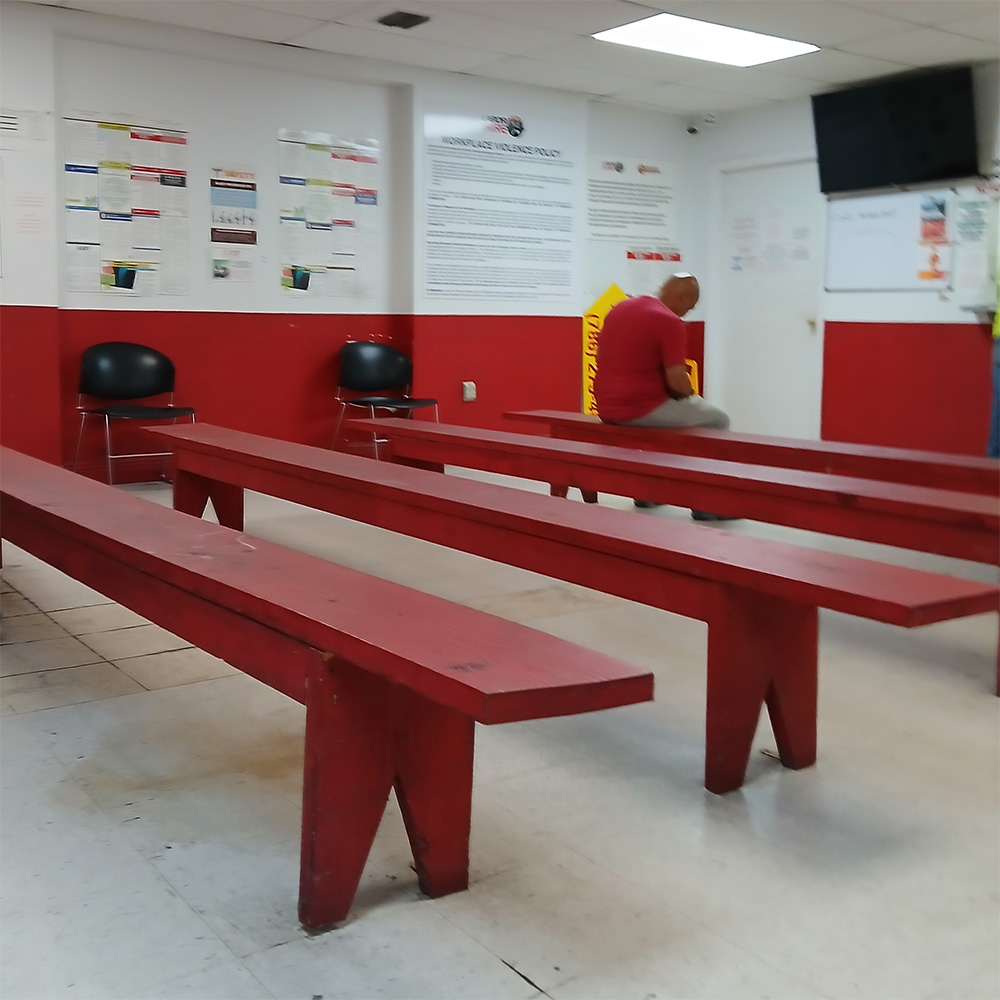

But finding work through a labor pool is by no means a guarantee. Robert, a Beyond the Bars member, waited days before he got work through a labor pool, showing up every morning at 4:30 am before finally getting a single five-day assignment. “I was under a lot of pressure, not just from the probation officer but from the landlord,” he said. “The landlord was only going to let me stay for so long. She’s gotta pay her rent, too. The probation officer was putting pressure on me because I had to pay fines and restitution fees. If I hadn’t found work, I probably would have been violated.” Instead of enduring the uncertainty of the labor pool, he took to his bike, “riding here, riding there” until he found a permanent job cleaning buses. But it took months.
In essence, labor pools occupy a middle ground between informal “day labor” corners (in which workers and employers contract directly, typically in public spaces such as Home Depot parking lots, often on a cash basis with only the most informal of agreements in place) and a conventional temp agency (at which workers might go through a more formal application and interview process and await placement rather than compete for work at a daily labor hall).
Regardless of whether a worker is employed through a labor pool or a more conventional temp agency, they are likely to show up at the job site with little preparation. “They don’t even train you. They just expect you to know,” said Charles, a Beyond the Bars member who frequently works temp jobs. “They want you to come already prepared.” And workers typically do not know their wage rate, the potential safety hazards on the job, or length of assignment before they are sent out to work.
At the labor pools we visited in Miami-Dade and Broward counties, workers typically arrived between 4:00 and 5:00 a.m. They check in and provide basic information to establish employment eligibility and input payroll information.
Workers wait, sometimes for hours, to see if they receive a “ticket”—essentially, a job for that day. A ticket is a physical work order issued by the agency listing the host employer, job site address, shift start time, and assigned workers. Each morning, labor pools receive calls from host employers indicating how many positions are available and at which locations. That information determines how many tickets the agency issues throughout the day. Selected workers bring their tickets to the job site, where it functions as proof of placement that allows the agency to track hours to bill to the host employer, and deduct fees such as transportation or equipment costs from the worker’s paycheck.
Labor pools wield near-total control over who works each day and where they are sent to work, as administrative staff decide not only which workers receive assignments but also whether they get the more desirable placements in warehouses or the grueling, low-paying cleanup jobs on construction sites. These decisions are opaque, subjective, and often appear to be driven by favoritism or personal connections.
While administrative staff often claim that workers are chosen in order of check-in time, this is rarely the case. Beyond the Bars members report that some workers appear to receive preferential treatment, yet those decisions are made with little to no information about the workers themselves, as labor pools do not conduct interviews, request résumés, or evaluate skills. Many workers who seek placements through labor pools never receive an assignment at all, yet they continue showing up day after day, hoping for a chance at work that never comes.
These selection practices mirror broader patterns in the temp industry. At a conventional temp agency, Wes, a Beyond the Bars member quoted earlier, described how his friend was offered a supervisory position for the day while Wes himself was categorized as a “general laborer.” “There was no résumé given, no additional information. They had no context to actually make this decision other than their immediate impressions of meeting us during a 15-minute group interview,” he explained. When asked why he thought that happened, another Beyond the Bars member chimed in that Wes’s friend was a white-passing Cuban worker, which carries significant social currency in Miami, while Wes is a darker-skinned person of mixed ethnicity.
Such practices open the door to discrimination based on race, national origin, gender, prior involvement with the carceral system, or even a worker’s decision to assert their rights.88 When asked what happens if someone refuses a job—for example, because the worksite is unsafe or they were underpaid on a previous assignment—one Beyond the Bars member, Felix, responded without hesitation: “You don’t get a ticket,” potentially ever again.
With so many moving parts, it can be difficult to know where to ground our strategy. The labor movement’s experience has taught us to focus on where the money (and power) really lies: with the large client companies that set the terms for the contractors and suppliers they hire. This is sound wisdom, especially since most temp agencies lack the name recognition and deep pockets of their clients.
But it would be a mistake to ignore the inner workings of the temp industry itself. By examining how the temp industry really works—for example, shifting accountability between two bosses, suppressing wages, exploiting hidden subsidies, and erecting barriers to permanent work—we gain valuable insights into how to build a strategy to move clients, policymakers, and the public to take meaningful actions to reform the industry and strengthen the power of the workers within it.
With that said, here’s how the industry really works.
Make Temp Workers Report to Two Bosses…
Temp work is one form of contingent work, a broad category now present in virtually every sector of the economy that includes the overlapping categories of contract workers, misclassified independent contractors, day laborers, and part-time workers.89 In this report, we are referring specifically to workers at temp agencies who are direct employees of the temp agency, which is the employer of record. At tax time, they will receive a W2 from the temp agency, regardless of how many different host employer worksites they staffed during the year, not a 1099 like an independent contractor receives.
Serving as the employer of record is central to the value temp agencies claim to offer their clients. Agencies promise to deliver ready-to-work employees on short notice while sparing companies the costs and risks of traditional hiring. They handle recruitment, skill assessments, background checks (primarily for white-collar placements), employment eligibility verification, payroll processing, and, when applicable, benefits administration.
As the employer of record, the agency is also responsible for unemployment insurance and workers’ compensation claims and is officially viewed as the entity that hires or terminates a worker, though, in fact, the host employer controls when an assignment begins and ends. The temp agency assumes the role of legal employer in exchange for a fee it takes from the worker’s hourly wage—an amount that is kept hidden from the worker.
What temp agencies don’t typically do is actually supervise the employees. That function is generally left to the host employer. Temp workers often work alongside the host employer’s direct employees, performing the same tasks, using the same equipment, and receiving direction from the host employer’s managers for less pay and usually without benefits.
In a traditional employment relationship, the legal employer (the employer of record) both directs the work and benefits from it, deciding how it’s done, reaping the profits it produces, and investing in the tools or infrastructure needed to sustain it.90,91 Temp agencies, however, claim the legal status of employer while exercising little control over the conditions, outcomes, or methods of work. This arrangement allows the host employer to avoid liability under labor and employment laws by asserting that the temp agency, not the client, is the legal employer.
The reality is that these blurred lines are a deliberate feature of the temp industry, not a bug.92 This three-way employment relationship—temp worker, temp agency, and host employer—enables the abusive practices that allow both employers to drive down labor standards, evade responsibility, and exert almost total control over temp workers, especially workers with records who are highly dependent on temp agencies for their employment.
Take, for example, what happened to Andrea, a Beyond the Bars member who aspired to become a medical assistant and earned a certification in the field. She was hired at a private medical clinic but was let go after the employer completed a background check and learned her incarceration history. Eventually, she got a job through a temp agency at a lab that processed medical samples. One day, she was processing a urine sample in an autoclave. When the machine stopped spinning and she went to retrieve the sample, it popped open and splattered her in the face. She soon learned the patient had herpes.
When I reported this through the temp agency, they told me no, I have to report it through [the host employer],” she said. “When I told [the host employer], they said no, I’m not an employee of theirs, I’m an employee of the temp agency. We were going back and forth, and I ended up paying for [my doctors’ visits] myself.
This arrangement, in which a temp worker effectively reports to two different bosses, creates confusion, strips workers of rights, and opens the door to abuse. If a worker is injured on the job, who is responsible: the host employer that controls the workplace, or the temp agency listed as the employer of record for workers’ compensation purposes? And if a worker isn’t paid for all the hours they worked, who is on the hook for wage theft: the agency that processed the payroll, or the host employer that directly benefited from their labor? Temp workers and worker centers have been able to retrieve millions of dollars lost through this kind of wage theft, but this represents only a small portion of the problem.
When his temp agency lost his completed job ticket for the day, Michael, the Beyond the Bars member mentioned earlier, found himself in exactly this situation. First, he went to the job site, but, as he put it, “there was no sense of urgency just because you’re a temp worker. They don’t feel like your money is important.” But of course, that money is important, especially to a worker living paycheck to paycheck. The temp agency said they would take care of it, but “the next week they forgot. My bills don’t forget. I owe them. So how are you going to forget if I came to you as a human being and told you what the situation was?”
Michael’s story reflects a widespread pattern of neglect and exploitation across the temp industry. A national survey found that one in four temp workers (24%) reported that their employers had stolen wages from them by paying less than the minimum wage, failing to pay overtime, or failing to pay for all hours worked. One in six (17%) reported experiencing a work-related injury or illness while employed through a temp agency, and among those injured, 41% said they personally covered their healthcare costs, either out of pocket or through their own insurance. Meanwhile, seven in ten (71%) temp workers reported experiencing retaliation for raising workplace issues with a supervisor or management.93
Health and Safety Falls Through the Cracks
Given these gray areas, it’s no great surprise that temp workers are more likely to be injured on the job. “Temp Land,” a 2013 series by ProPublica, was one of the first major journalistic investigations into the risks of temporary employment. In one article, “Temporary Work, Lasting Harm,” reporters analyzed workers’ compensation claims across five states and found that temp workers faced significantly higher injury rates.
In Florida, temps were 50 percent more likely to be injured as compared to permanent employees.94 A 2010 study in the American Journal of Industrial Medicine found that temp workers in Washington State’s construction and manufacturing sectors were twice as likely to file workers’ compensation claims as their directly employed counterparts. The study also reported that injured temp workers lost more work time, on average, than permanent employees.95
“After incarceration, I was placed in different warehouses doing laborer work, maintenance, and machine repairs,” Alejandro, a temp worker, told Beyond the Bars. “Some of the warehouses didn’t care at all about the safety of employees. I got a couple of burn marks and hits. I never got any benefits, health insurance, or even training. They don’t pay enough for the risk and amount of physical exhaustion this work takes.”
Labor pools, where workers may work at a different worksite almost every day, provide particular challenges when it comes to safety. Beyond the Bars members report that while workers do get personal protection equipment from the labor pool before they are sent to an assignment and take a short online safety training when they first register, they typically do not get any site-specific safety training once they get to the worksite.96
Despite this fact, federal agencies seldom focus on temp agencies for safety enforcement. Since 2015, the U.S. Occupational Safety and Health Administration (OSHA) has issued only 34 citations to temp agencies in Florida. These citations resulted in $368,982 in fines, though these were later reduced to $261,457. In many cases, employers negotiate lower fines as part of settlements focused on remediation rather than litigation.97 (See Appendix)
Several factors may explain the relatively low number of OSHA citations against temp agencies. Temps may be less likely to report hazards due to the precarious nature of their employment and fear of retaliation. When OSHA does investigate hazards at workplaces where there are temps, it may only name the host employer in the citation, not the temp agencies on site.
…Then Exploit That Confusion
Temp agencies and host employers use the triangular employment structure to their advantage, gaming the system to maximize profit while shielding themselves from responsibility. They face little oversight, having successfully lobbied to exempt themselves from most state regulations. While they are governed by existing federal statutes, such as the Fair Labor Standards Act (FLSA), many agencies deliberately operate with little cash and few assets, leaving workers unable to collect damages even when they win in court. In practice, this lack of accountability allows modern temp agencies to function much like 19th-century labor brokers who met immigrants at ports of entry and funneled them into exploitative, dangerous work.98
The workers’ compensation and unemployment insurance systems are especially susceptible to abuse, as they have not evolved to effectively deal with the reality of widespread temp work. Like car insurance, both systems calculate premiums based on risk: more injuries or layoffs mean higher rates. But the presence of two employers creates gray areas that temp agencies and host employers routinely exploit.
For example:
01. The workers’ compensation blended-rate loophole:
Workers’ compensation premiums are based on an employer’s risk profile. To cut costs, temp agencies strategically bundle their workers—those in high-risk jobs such as heavy manufacturing with those in low-risk jobs like clerical or technical professions—into a single insurance pool. This blending artificially lowers their overall risk rating and premium, allowing agencies to keep sending temps into hazardous worksites at bargain-basement prices.
02. The experience rating game:
Workers’ compensation and unemployment insurance premiums are partly based on an employer’s “experience rating,” which rises when workers file claims for injuries or layoffs, much like how car insurance premiums increase after an accident.
Layoffs: Temp agencies may manipulate unemployment insurance rules to avoid reporting layoffs. When a host employer reduces its temp workforce, the agency may transfer those workers to other clients. If no suitable work is available, agencies sometimes resort to unfair tactics that allow them to classify the worker as a “voluntary quit,” and therefore ineligible for unemployment benefits. For example, they may offer a position they know the worker cannot accept, such as one located far away or requiring physical tasks the worker cannot perform. Hence, they don’t accumulate experience points and are shielded from higher insurance rates.99
Workplace injuries: Experience ratings follow the employer of record, which in the temp industry is the temp agency, not the host employer, despite the injury having occurred under the host employer’s watch. This loophole allows the host employer to benefit financially without actually improving safety, as they can make injuries to temp workers effectively disappear from the record for the purposes of calculating insurance rates for that particular worksite.100
Because agencies are penalized for injuries that occur under the supervision of the host employer, they have a strong incentive to dissuade injured employees from filing workers’ compensation claims. As described in the previous section, Andrea’s experience being directed by the temp agency to the host employer for redress, despite the agency being the legal employer of record, reflects a common tactic used to suppress claims and keep premiums low.
If workers persist and successfully file claims, the agency’s insurance costs rise. At that point, the agency faces two options: pass the cost to the client, risking the loss of its contract to a cheaper competitor; or absorb the cost itself, cutting into already thin profit margins, cutting corners elsewhere, or shutting down and reincorporating under a new name to reset its rating.
In either case, host employers evade any financial consequences for injuries that occur under their supervision. If a temp agency attempts to pass costs along, the host employer can simply contract with another agency.
In effect, the experience-rating system in the context of the temp industry rewards both sides for skirting workplace health and safety rules: temp agencies for suppressing claims, and host employers for outsourcing danger.
03. The reappearing act:
Even when experience points accumulate and insurance costs rise, temp agencies still have ways to avoid the consequences by simply closing and reincorporating under a new name. Starting a temp firm requires little capital or specialized equipment, and, in most states, no licensing.101 Recruiters’ relationships and knowledge of the local labor market, their most important asset, transfer seamlessly to the new entity, letting agencies reset their rates and resume business as usual.102 Temp agencies use the same strategy to evade other liabilities, including wrongful termination claims,103 further shielding agencies from accountability within an already opaque system.
04. The indemnification scheme:
The workers’ compensation system is a “grand bargain:” workers give up the right to sue their employer for job-related injuries, and in return, employers provide no-fault coverage for associated medical care, lost wages, and related costs. This trade-off isn’t something workers agree to individually, instead, it’s established by state law. As Florida’s workers’ compensation statute states, the system is based on a “mutual renunciation of common-law rights and defenses.”104 As such, the workers’ compensation system becomes the sole remedy for injured workers, shielding the employer from potentially expensive and unpredictable litigation.105
The temp agency, as discussed before, is the temp worker’s employer of record. Because the workers’ compensation system is an employee’s sole remedy, an injured temp cannot sue the temp agency.
But could the worker sue the host employer if conditions under their supervision contributed to their injury?
To shield host employers from liability, temp agencies and their clients typically use three interrelated strategies when structuring their agreements, each designed to prevent temp workers from bringing workplace injury claims against the host employer.
- The temp agency and the client sign an indemnification agreement that seeks to transfer all risk for workers’ compensation claims to the temp agency and exempt the client from any injuries to temps on its premises.106
- The temp agency then designates the client as an “alternate primary employer” on its workers’ compensation policy, which the parties believe will shield the client from injury-related lawsuits. In essence, this designation aims to establish that an injured worker’s only avenue for seeking compensation from the host employer is through the workers’ compensation system itself, rather than through civil litigation.107
- Finally, the temp agency often includes a “waiver of subrogation” clause in its contract with the client, intended to prevent the agency’s insurance carrier from seeking damages against that client. As the law firm Conroy Simberg explains, subrogation allows an insurer “to step into the shoes of the policyholder and file a claim against a third party who caused the damage.”108 By waiving this right, the temp agency effectively declares that its insurer cannot sue the client for reimbursement. This arrangement is unusual, however, because the insurance company itself is not a party to the agreement, and thus has not consented to the waiver.
The combined effect of these three strategies, the client hopes, is an iron-clad protection against any litigation related to workplace injuries.
Walk a Tightrope When It Comes to Pricing
Temp agencies are typically left with a razor-thin profit margin, which creates powerful incentives to improve that margin by cutting corners.109
Temp agencies make money by charging host employers a percentage markup on each worker’s hourly wage, typically between 20 and 50 percent for blue-collar jobs.110 For example, a host employer might pay $21 per hour for a worker’s labor, while the temp agency pays the worker $14 per hour, keeping the remaining $7 as its fee. This markup is meant to cover recruiting, background checks, payroll administration, unemployment insurance, workers’ compensation, and any benefits the agency provides.111 But even a 40 percent markup on a $14 hourly wage amounts to just $5.60 per hour, leaving little room for profit after expenses. That’s a long list of expenses, paid from a relatively small pool of money.
In theory, temp agencies should want to raise workers’ wages, since their markup is based on a percentage of a workers’ hourly pay. In practice, though, that incentive disappears because host employers firms turn to temp agencies precisely to cut their labor costs. Agencies compete by offering the lowest possible rates, which pushes wages, and their own profit margins, downward.
The industry’s hypercompetitive, low-barrier-to-entry nature intensifies this dynamic. With countless agencies vying for the same clients, firms can easily pit them against one another in search of a better price. Because labor costs make up most of a temp agency’s total bill, agencies have little choice but to underbid competitors by lowering workers’ hourly rate to get their piece of the pie. The result is a race to the bottom that erodes both wages and margins, a self-defeating cycle that may have slowed the sort of large-scale outside investment that could lead to explosive growth and industry consolidation.
An unusually candid piece from the private equity firm Mirus Capital Advisors provides real insight into the inherent problems in the temp industry’s business model. “The truth of the matter is that there are not a whole lot of private equity firms that make investments in the staffing industry,” the firm writes. “[T]he highly fragmented and competitive nature of the market…has led to a situation where competition is often solely based on price. From a [private equity] firm’s point of view, that looks like a race to the bottom.”112
Do Temp Workers Get Benefits?
Laws and the structure of the temp industry reduce temp workers’ access to benefits. Consider, for example, paid sick leave.113 Only eleven states have laws requiring employers to provide workers paid sick leave. Two of those states (Connecticut and Maryland) explicitly exclude temps from that requirement. One more (Michigan) implicitly excludes temps.114
Even in states without formal exclusions, temp workers face differential treatment. In Rhode Island, for example, the law allows employers to mandate that a full-time worker wait 90 days after their start date to utilize paid sick leave, while temp workers may be asked to wait 180 days. Given that the average temp worker’s tenure is around 10 weeks,115 most temp workers under these laws never become eligible for paid sick leave.
Drew, a Florida temp worker interviewed by Beyond the Bars, describes it this way:
“After incarceration, I was placed in a flower shop warehouse. The work itself was okay, and it felt like a safe place, but that didn’t mean we were treated fairly. There were no benefits, no health insurance, no paid time off, nothing. And having a record? That’s where the real challenge came in. Discrimination happened sometimes, like I wasn’t worth the same respect or opportunities as other workers, even though I was doing the same, if not harder, work.”
In states that do have paid sick leave laws, employees accrue sick time based on hours worked.116 Under this scheme, even temp workers who make it past the waiting period may not qualify because of the irregular work schedules common in the industry. Further, eligibility and accrual do not transfer to host employers if temp workers are hired directly by the host employer.117
While the information is dated, the U.S. Census Bureau’s 2017 Contingent Worker Supplement suggests that temp workers are also less likely to have health insurance. Overall, 67.3 percent of temp workers had health insurance, compared to 83.5 percent of workers with traditional employment relationships, according to the Census data. Only 12.8 percent of temp workers, however, had employer-provided coverage—a striking discrepancy.118 Although the Census tables do not break down these figures further, it is reasonable to assume that the remaining 54.5 percent of temp workers with non-employer-provided insurance relied on public programs such as Medicaid or marketplace subsidies, given their low wages and lack of employer benefits.
None of the workers with records with whom Beyond the Bars did in-depth interviews had employer-provided health insurance while working as a temp.
Exploit Hidden Subsidies
Many of the practices described above are, in essence, a form of hidden subsidy, some of which may transfer costs to parties besides the temp agency and its client.
For example, if workers fall through the cracks and don’t get proper health care for workplace injuries, they may have to rely on hospitals and other public health resources for treatment. And if their injury is not adequately treated, it may limit their future earning potential or even their ability to work at all, leading to dependence on Supplemental Security Income (SSI), the federal disability assistance program for low-income individuals.
If blended rate loopholes or outright fraud leads to artificially reduced workers’ compensation premiums, it is possible that more responsible employers will have to pay higher rates. And if companies can limit workers’ ability to claim unemployment benefits, the costs of supporting displaced workers may be shifted to taxpayers and place additional strain on the public safety net.
But one program in particular stands out among these hidden direct subsidies: the Work Opportunity Tax Credit. Established in 1997, the WOTC is a federal tax credit designed to incentivize employers to hire individuals who face barriers to employment. The program identifies ten target groups, including “qualified ex-felons,” or people convicted of a felony under federal or state law who are hired within one year of their conviction or release from incarceration.119 The credit is reauthorized by Congress roughly every five years, usually with broad bipartisan support.
While Congress intended the WOTC to expand access to stable, long-term employment for marginalized workers, the program’s design rewards short-term placements instead. Employers become eligible for a minimum tax credit of $1,200 after retaining a worker for only 120 hours (about three weeks or 15 workdays) and can claim the maximum credit of $2,400 after 400 hours (around ten weeks or 50 workdays), except for certain qualified veterans, for whom the maximum credit is significantly higher. Despite operating for nearly three decades, the program has never undergone a comprehensive federal evaluation, leaving little evidence that it achieves its stated goals.120
A 2022 ProPublica investigation exposed how this structure drives low-quality, precarious employment. The article highlighted the case of DeMond Bush, a resident of Louisville, Kentucky, who, after struggling to find steady work following his release from prison, accepted a “temp-to-hire” warehouse position through Express Employment Professionals. He was told that after 90 days, he could be hired directly by the warehouse with higher wages and benefits. On his 90th day, however, the warehouse ran a background check, terminated his employment, and escorted him off the property. Shortly after losing the job, Bush became homeless and was sent back to prison for a technical violation of his parole. Yet to the federal government, this short-term placement qualified Express for a $2,400 tax credit; a clear example of how the WOTC rewards turnover rather than stability.121
Beyond the Bars members described a similar recurring pattern: being hired into temp positions, performing well, and earning praise from supervisors at the host employer, only to be terminated once a criminal background check was completed around the 90-day mark. Despite these short-term placements, the temp agencies that employed them almost certainly qualified for a federal tax credit in at least some of these cases.
Members also reported that when applying for day-labor jobs through labor pools, one of the first forms they are asked to complete is IRS Form 8850, officially titled the Pre-Screening Notice and Certification Request for the Work Opportunity Credit.122 The form collects information on factors such as veteran status, public assistance history, and felony conviction. To qualify for the subsidy, both the worker and employer must sign the form on or before the job offer date, effectively transforming workers’ personal hardships into a source of financial benefit for employers.
These tax credits can have a major impact on the profitability of temp agencies that operate largely in “industrial” sectors. According to ProPublica, Kelly Services reported receiving tax credits (primarily WOTC) worth $164 million over ten years, equal to 48 percent of its U.S. pre-tax earnings, while TrueBlue, which owns the day-labor firm PeopleReady, reported $114 million over the same period, or 29 percent of its pre-tax income. The credits reduced TrueBlue’s federal income taxes by 69 percent and Kelly’s by 73 percent.
Temp agencies, many with “long records of labor violations,” make up a disproportionate share of WOTC beneficiaries.123 Yet the WOTC sets no standards for job quality or wages, effectively subsidizing the exploitation of criminalized labor under the guise of rehabilitation.124 The WOTC thus exemplifies the temp industry’s false benevolence, one that cloaks systemic exploitation in the language of opportunity.125
Erect Obstacles to Permanent Work
Earlier in this report, we examined the contractual relationships between reentry organizations and temp agencies that make it difficult for workers to secure stable employment. These challenges are compounded by broader industry practices that actively prevent temp workers from moving into full-time positions.
At the center of this dynamic is one of the industry’s most persistent myths: that temp work serves as a pathway to permanent employment. For workers struggling to rebuild their lives or find a job with a future, the language temp agencies use can be seductive. Agencies market themselves as gateways to opportunity, promising upward mobility and personal growth:
“We improve lives by providing jobs and talent that help our clients, associates and team members grow.”126
“We create opportunities for people to find meaningful work and build skills that will last a lifetime.”127
“Our people-focused approach connects quality talent with meaningful contract, temp-to-perm and long-term opportunities.”128
“We don’t just fill positions; we build careers and companies.”129
For many temps, the reality is very different. “Finding steady work has been the hardest part. I got a job at Mattress Firm through an agency, learned the job fast, and was ready to stay,” said David, the Beyond the Bars member mentioned earlier in this report. “I worked as a selector, preparing the shipments, and I learned the computer systems. There was no limit to what we could achieve there. But when it came time for them to hire me permanently, they dropped me because of my background. It’s frustrating.”
Cam, another Beyond the Bars member, similarly described his experience:
“After incarceration, I was placed as a temp on a construction site and ended up working for the same company for nine years… I did the same job as direct employees, sometimes even more, but because of my record, they never offered me a permanent position. No benefits, no security—just years of labor, only to be treated like I was disposable.”
Some host employers may be reluctant to convert temp workers into permanent staff, but temp agencies also have clear financial incentives to retain their workers. As the ASA noted in a 2022 report, “Employees are a staffing agency’s most important asset… Once an individual has been employed, the staffing agency has an economic interest in retaining that employee.”130 Law Professor Andrew Elmore interviewed Beyond the Bars members who worked as temps after leaving incarceration and concluded that “Interviewees . . . were never directly hired by employers, or if they eventually were, they worked years and even decades as temps before finding permanent work.131
This self-misrepresenting scam is at the heart of the temp industry—the false promise that temp work is a stepping stone to permanent employment. Intake practices and rhetoric at some temp agencies mimic traditional hiring, giving workers the impression that they are entering a pathway to long-term stability. As scholar Emine Fidan Elcioglu observes, agency staff often describe themselves as talent “agents,” telling workers to “make believe that [they]’re an athlete or movie actor.”132 Yet few workers ever receive written confirmation of a “trial period,” performance criteria, or hiring timeline.133 Even when they excel, permanent positions may never materialize at all.
One key mechanism that reinforces this cycle is the placement fee (sometimes called a conversion fee), which is a charge that agencies require host employers to pay before hiring a temp directly. These fees are typically calculated as a percentage of the worker’s first-year salary, typically ranging from 20 to 50 percent.134 For example, a 20 percent placement fee for a full-time worker earning $15 per hour would exceed $6,000. Such costs often discourage employers from offering permanent positions, even when workers have proven their value.
Michael, another Beyond the Bars member, experienced this firsthand. “One time I was at a site and they [said], ‘Hey, we love your work ethic, we want to hire you,’” he said. The offer was appealing—higher pay, better treatment, more hours. But there was a catch. The temp agency was trying to charge a placement fee before the host employer could hire him, and the price was too steep. “Y’’all don’t own me. I work for ya’ll, but y’all don’t own me,” he said, reflecting later on the moment. “So why can’t I go to a better company to better myself?”
When he finally did secure a permanent position, the difference was stark: “It was like night and day. I was treated with more respect, paid way better, got more hours—they made me feel like I was worth something. At the temp agency, I was just a body.”
Although some contracts reduce placement fees to zero after 90 days, others extend them much longer. Because these agreements are rarely public, there is little systematic data on their use. In a 2020 Journal of Law and Society article, Jane Flanagan, now Director of the Illinois Department of Labor, argued that such clauses “explicitly discourage worksite employers from hiring temps into permanent jobs,” undermining both workers’ interests and those of employers who want to retain reliable staff.135
While placement fees are legal, some temp agencies go even further, blacklisting workers or entering into “no-poach” agreements that effectively bind temps to a single agency.136 In November 2024, Illinois Attorney General Kwame Raoul reached a $1.8 million settlement with Metro Staff Inc., which allegedly conspired with other temp agencies to refuse to recruit or hire each other’s employees and to fix wages. His office later settled with Elite Staffing, Metro Staffing, and their client Colony Display LLC, recovering a total of $5.5 million.
According to the Attorney General, such arrangements “eliminated competition and harmed temporary workers by interfering with their ability to seek better employment opportunities, wages, and benefits.” These no-poach schemes not only suppress wages but also create powerful disincentives for workers to speak out about unsafe or unfair conditions.137
Together, the very business model of the temp industry creates challenges to organizing workers in this industry, which we will later discuss how to use to create leverage in Part IV.
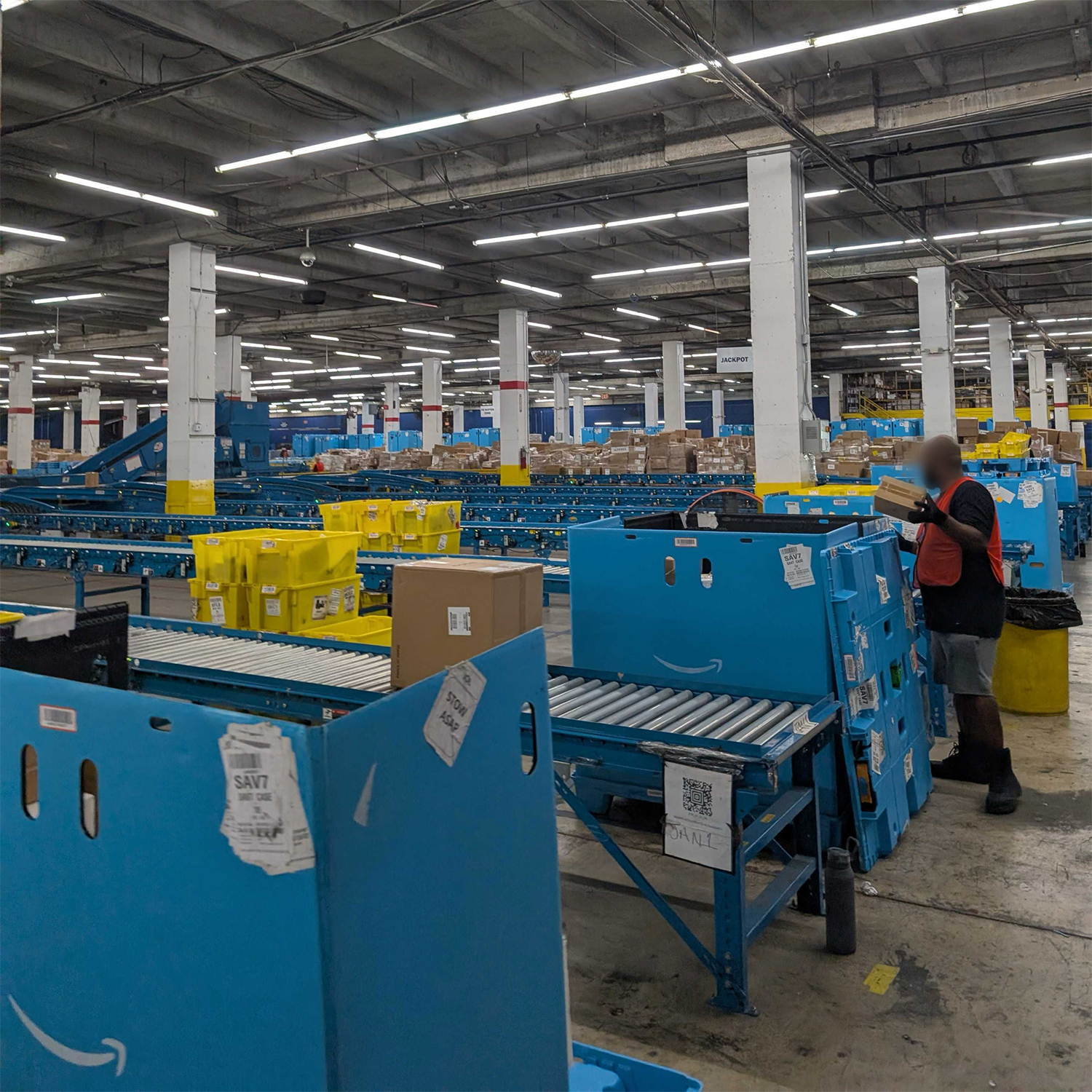
A Miami warehouse illustrates the dynamics of modern subcontracting. Line workers at this warehouse—many of whom have criminal records—are employees of temp agencies, while managers work directly for the host employer, a global transport and logistics company that provides services to Amazon and other major corporations. On one shift, as few as five directly employed managers oversaw more than one hundred temporary workers, aided by surveillance cameras positioned throughout the facility. This arrangement exemplifies the triangular employment relationship that allows host employers to disclaim liability for workplace conditions—even as they control the work itself—while keeping labor costs low.
footnotes
- Erin Hatton, The Temp Economy: From Kelly Girls to Permatemps in Postwar America (Philadelphia: Temple University Press, 2011).
- Fla. Stat. § 448.22.
- Group interview with Beyond the Bars members, September 18, 2025.
- Action Center on Race and the Economy, et. al., Untangling Discrimination: How Temp Agencies Exploit Race, Gender, and Criminal Records to Divide Workers and Drive Down Wages (Dec 2023). https://acrecampaigns.org/wp-content/uploads/2023/12/Untangling-Discrimination-FINAL-DIG-REPORT.pdf
- See, for example, Erin Hatton, The Temp Economy: From Kelly Girls to Permatemps in Postwar America. Temple Univ. Press, 2011, p. 11.
- Interview with George Gonos, March 18, 2025.
- George Gonos, “The Contest Over ‘Employer’ Status in the Postwar United States: The Case of Temporary Help Firms,” Law & Society Review 31, no. 1 (1997): 81–110. Harris Freeman and George Gonos, Taming the employment sharks: The case for regulating profit-driven labor market intermediaries in high mobility labor markets. 13 Emp. Rts. & Emp. Pol’y J. 285 (2009).
- Purser, “‘Still Doin’ Time.’” Elcioglu, Producing Precarity, 127.
- National Employment Law Project (2022). Survey of Temp Workers Spotlights Widespread Industry Abuses: Poverty Pay, Permatemping, Wage Theft, Unsafe Conditions. Retrieved from https://www.nelp.org/survey-of-temp-workers-spotlights-widespread-industry-abuses-poverty-pay-permatemping-wage-theft-unsafe-conditions/
- Michael Grabell, Jeff Larson, and Olga Pierce, “Temporary Work, Lasting Harm,” ProPublica, December 18, 2013, https://www.propublica.org/article/temporary-work-lasting-harm.
- Caroline K. Smith et al., “Temporary Workers in Washington State,” American Journal of Industrial Medicine, 53:135-145, 2010, https://pubmed.ncbi.nlm.nih.gov/19618410/.
- Group interview with Beyond the Bars members, September 18, 2025.
- OSHA, Inspections Within Industry (data current through September 23, 2025), https://www.osha.gov/ords/imis/industry.html, for NAICS Code 561320 within the state of Florida.
- Gunther Peck, Reinventing Free Labor: Padrones and Immigrant Workers in the North American West, 1880-1930. Cambridge: Cambridge University Press, 2000.
- Chirag Mehta and Nick Theodore, “Paying the Price for Flexibility,” WorkingUSA, August 20, 2004, https://onlinelibrary.wiley.com/doi/abs/10.1111/j.1743-4580.2002.00008.x-i1. Laura Padin, Eliminating Structural Drivers of Temping Out: Reforming Laws and Programs to Cultivate Stable and Secure Jobs (National Employment Law Project, 2020), https://www.nelp.org/app/uploads/2020/03/Policy-Brief-Eliminating-Structural-Drivers-Temping-Out.pdf.
- Padin, Eliminating Structural Drivers of Temping Out.
- Padin, Eliminating Structural Drivers of Temping Out.
- Padin, Eliminating Structural Drivers of Temping Out.
- Interview with George Gonos (Mar. 18, 2025).
- 2025 Florida Statutes, 440.015, https://www.leg.state.fl.us/statutes/index.cfm?App_mode=Display_Statute&URL=0400-0499/0440/0440.html.
- “Bargaining Power,” WC, Summer 2018, https://s27147.pcdn.co/app/uploads/2018/06/Workers-Compensation-WC-Summer-2018_DBarticle.pdf.
- “The Intersection of Workers’ Compensation Immunity and Contractual Indemnity,” National Law Review, October 22, 2019, https://www.natlawreview.com/article/intersection-workers-compensation-immunity-and-contractual-indemnity.
- International Risk Management Institute, https://www.irmi.com/term/insurance-definitions/alternate-employer-endorsement. Indiana Compensation Rating Bureau, https://www.icrb.net/references/alternate-employer-endorsement/#:~:text=An%20alternate%20employer%20endorsement%20extends,in%20the%20policy’s%20endorsement%20schedule.
- Conroy Simberg, “The Facts About Waiver of Subrogation Clauses,” December 15, 2022, https://www.conroysimberg.com/blog/the-facts-about-waiver-of-subrogation-clauses/#:~:text=Subrogation%20allows%20an%20insurer%20to,to%20blame%20for%20the%20damages. See also, Weber Gallagher, “Who’s Who: Temporary Staffing Agencies and Subrogation Interests,” August 5, 2014, https://www.wglaw.com/Trending/Blogs/109171/Whos-Who-Temporary-Staffing-Agencies-and-Subrogation-Interests.
- Because of their low margins, larger temp agencies are eager to sell clients other, higher-profit services such as executive recruiting. More sophisticated temp agencies have offered to act as a “managed service provider” (MSP) capable of coordinating all of a company’s outsourcing, from cleaning companies to freelance professionals. Some MSPs even hire and manage other, smaller temp agencies. A handful of large temp agencies offer to do more than just supply the labor by marketing “on-site services” in which they also manage employees and assume responsibility for delivering a product or service to the host employer’s specifications.
- Analysis by the authors of temp agency contracts retrieved from PACER searches.
- See for example, Flanagan, “Fissured Opportunity,” 9.
- See, for example, “Why Doesn’t Private Equity Like Staffing?,” Mirus Capital Advisors, archived at Internet Archive, July 5, 2022, https://web.archive.org/web/20220705010510/https://merger.com/private-equity-staffing/.
- Padin, Eliminating Structural Drivers of Temping Out.
- Padin, Eliminating Structural Drivers of Temping Out.
- ASA, Staffing Employment Sets Record High in 2018, (Mar. 14, 2019), https://americanstaffing.net/posts/2019/03/14/staffing-employment-sets-record-high-in-2018/
- Padin, Eliminating Structural Drivers of Temping Out.
- Padin, Eliminating Structural Drivers of Temping Out.
- BLS, Economic News Release, “Contingent and Alternative Employment Arrangements News Release,” June 7, 2018, https://www.bls.gov/news.release/conemp.htm.
- Internal Revenue Service. “Work Opportunity Tax Credit.” Accessed November 2, 2025. https://www.irs.gov/businesses/small-businesses-self-employed/work-opportunity-tax-credit.
- National Employment Law Project, National Legal Advocacy Network, Temp Worker Justice, Action Center on Race & the Economy, CLASP, et al. (2023, April 24). Comments in Response to 88 FR 10540 [PDF]. Retrieved from https://www.nelp.org/app/uploads/2023/04/NELP-NLAN-TWJ-ACRE-CLASP-et-al-Comments-in-Response-to-88-FR-10540.pdf
- Emily Corwin, “A Tax Credit Was Meant to Help Marginalized Workers Get Permanent Jobs. Instead It’s Subsidizing Temp Work,” ProPublica, August 23, 2022, https://www.propublica.org/article/work-opportunity-tax-credit-temp-permanent-employment.
- Group interview with Beyond the Bars members, September 18, 2025.
- Corwin, “Tax Credit Was Meant to Help Marginalized Workers.”
- Han Lu, Worker Power in the Carceral State: 10 Proposals for a New Reentry Agenda (National Employment Law Project, April 2023), https://www.nelp.org/publication/worker-power-in-the-carceral-state.
- Purser, “‘Still Doin’ Time.’”
- Active Staffing Services, Active Staffing, 2024, https://www.activestaffing.com/
- Active Staffing Services, Active Staffing, 2024, https://www.activestaffing.com/
- Aerotek, Careers at Aerotek, https://www.aerotek.com/en/career-opportunities
- AppleOne, Welcome To Employment Staffing at AppleOne, https://www.appleone.com/
- Arthur L. Herold Webster, Chamberlain & Bean LLP, “Antitrust Considerations for Staffing Agencies Seeking to Retain Their Employees,” ASA Issue Paper, https://americanstaffing.net/posts/2022/06/23/asa-publishes-updated-antitrust-issue-paper/.
- Andrew Elmore, “Mobility and Power in Temp Work,” 51 B.Y.U. L. Rev. 101, 143, Oct. 7, 2025, https://papers.ssrn.com/sol3/papers.cfm?abstract_id=5556759.
- Elcioglu, Producing Precarity, 24.
- Interview with George Gonos (Mar. 18, 2025).
- Jane Flanagan, “Fissured Opportunity: How Staffing Agencies Stifle Labor Market Competition and Keep Workers ‘Temp,’” Journal of Law and Society 47, no. 4 (2020): 9.
- Flanagan, “Fissured Opportunity,” 11-14.
- Flanagan, “Fissured Opportunity,” 11-14.
- Office of Illinois Attorney General Kwame Raoul, “Attorney General Raoul Reaches $1.8 Million Settlement With Temporary Staffing Agency for Use of No-Poach and Wage-Fixing Agreements, November 19, 2024, https://illinoisattorneygeneral.gov/news/story/attorney-general-raoul-reaches-18-million-settlement-with-temporary-staffing-agency-for-use-of-no-poach-and-wage-fixing-agreements#:~:text=Raoul’s%20lawsuit%20further%20alleged%20that,employment%20opportunities%2C%20wages%20and%20benefits. See also, Office of Illinois Attorney General Kwame Raoul, “Attorney General Raoul Reaches $1 million Settlement With Temporary Staffing Agency for Use of No-Poach Agreements, Wage Fixing,” June 27, 2025, https://illinoisattorneygeneral.gov/news/story/attorney-general-raoul-reaches-1-million-settlement-with-temporary-staffing-agency-for-use-of-no-poach-agreements-wage-fixing.
Want future reports + tools?
Subscribe to The Work Release to get new publications, campaign updates, and worker stories.