Introduction
There’s a pervasive myth about temporary work, built right into its name. While some people turn to temp agencies to bridge short gaps between jobs or pick up a few extra hours, the reality for many is that these positions are anything but temporary.
For some people, this means “permatempting,” or working for years in the same position for the same company through a third-party temp agency instead of being hired directly by the company.
For example, a factory might rely on the same temp worker to work on production lines for years—sometimes even as a team lead—assigning full-time schedules and long-term duties to the worker without ever hiring them directly. That leaves the worker without the job security or benefits of an employee who is hired directly. In some cases, that very same worker might apply for a direct position at the factory, only to be rejected and thrown back into the temp pool after a background check reveals a criminal record.
For other people, the lack of access to direct hiring means daily searches for work through a labor pool or trying to make ends meet with a series of short-term assignments through a conventional temp agency.
A temp worker might spend a few days on a construction site, clearing debris and hauling materials alongside permanent crews who operate heavy machinery to build a stadium for the 2026 FIFA World Cup. The next day, the worker returns to the same temp agency at dawn, hoping to be dispatched to another construction site for a different host employer. This cycle can continue for months or even years, as the worker moves from one short-term assignment to the next without a path to stability, recognition, or advancement.
Regardless of the form it takes, temp work is often a primary source of income. In fact, according to the Contingent Work Supplement to the Census Bureau’s 2023 Current Population Survey, 89 percent of workers employed by temp agencies reported temp work as their sole or primary job, challenging the common perception that it is only supplemental.18
Contrary to another misconception that temp work is for young people, 60 percent of the workers in the survey are older than 25, and 39 percent are older than 35. This means that temp work is not a brief stopgap for students or part-time earners, but a long-term reality for many adults supporting themselves and their families.19
This report examines Florida’s temp industry through the lens of one group in particular: people with records seeking to reenter the workforce in a state where temporary employment plays an important role in the labor market.
As noted above, Florida ranks third in the nation for the number of temp workers. In any given week, temp agencies across the state employ about 162,000 people.20 But that figure vastly understates the industry’s reach. Because most temp jobs last only days or weeks, more than 888,000 Floridians, or about 4 percent of the state’s population, cycle through temp work each year.21 In 2022, Florida temp agencies reported $10.5 billion in total payroll, contributing to an industry that generated $140 billion nationally.22 Industrial staffing—the sector covering blue-collar occupations—accounted for $36.5 billion of that total.23
At the same time, Florida also has the third-largest incarcerated population in the country, with roughly 157,000 people incarcerated in state prisons24 and another 55,763 people incarcerated in county jail facilities on any given day.25 These daily numbers understate the scale of the system: Florida sees over 350,000 unique jail admissions each year,26 a constant churn that destabilizes families and communities.
An additional 164,000 people are under state supervision,27 such as probation, at any moment—a figure that does not include the thousands more under county supervision. In Miami-Dade County, for example, nearly 18 percent of people under the control of the MDCR are on house arrest rather than in jail,28 yet these figures are not aggregated and reported at the state level. In total, about 6.2 million Floridians, or 36 percent of the state’s population, have a criminal record.29
As this report will detail, for many of these workers, temp agencies are one of the few employers willing to hire them.
Together, these figures reveal that Florida’s temp industry is not a marginal sector but a multibillion-dollar engine built on low-wage, easily replaceable labor. For workers with records, the numbers represent a system that profits from their exclusion from stable employment. Reforming this system is essential to any serious vision of worker justice and decarceration.
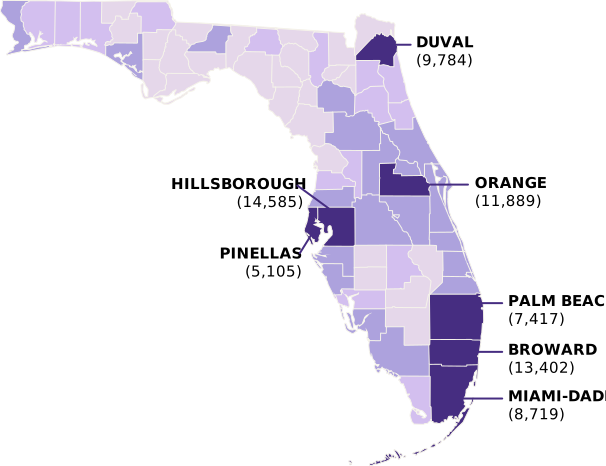
This report focuses on how these dynamics intersect most sharply in South Florida, where temp work is especially concentrated. Nearly one in five temp workers statewide (about 29,500 people, or 17 percent) are employed across Miami-Dade, Broward, and Palm Beach Counties.30
Figure 1: Number of Temp Workers by County
As this report will demonstrate, the cycle of precarious employment created by employers’ pervasive use of temp agencies—what we call “the temp trap”—is central to the experience of people returning from incarceration in South Florida. Temp work is often marketed as a bridge to stability. (An agency in Plantation, Florida, boasts: “At PrideStaff, it’s all about you. Whether you’re an entry-level worker or a senior executive, an HR Manager or a front-line supervisor, our goal is to understand what matters to you – your goals, your priorities, your success.”31) Instead, temp work functions as both a lifeline and a cage. As one worker told author Gretchen Purser, temp work feels like “still doin’ time.”32
Understanding this dynamic is at the heart of this report. Part 1 traces how state supervision requirements and the reentry ecosystem work together to funnel workers with records into temp agencies. Part 2 turns inward to examine the temp industry itself, exploring its business model, its profit structure, and the incentives that allow agencies to cut corners while workers bear the cost. Part 3 analyzes Florida’s legal and regulatory environment, revealing how weak enforcement and outdated statutes enable these practices to persist.
By unpacking the structural forces that shape the temp economy, we aim not only to critique these systems but to understand them deeply enough to craft smart, durable strategies for reform and power building. Part 4 concludes the report by outlining concrete strategies to improve standards across the industry and build lasting worker power, charting a path toward a labor market rooted in fairness, stability, and collective freedom.
This report draws on two years of field work, legal and policy research, and quantitative analysis conducted between September 2023 and September 2025. Our research included more than 180 surveys inside Miami-Dade jails; visits to 89 temp agencies and 58 reentry and workforce sites; 608 in-depth conversations with South Florida residents affected by incarceration; and structured workplace observations, alongside analysis of federal employment, wage, safety, and enforcement data.
Together, these methods offer a grounded picture of how temp work functions for people with records in Florida—how public policy, profit incentives, and supervision practices shape their employment opportunities—and what it will take to change these conditions through organizing and structural reform.
Footnotes
- contingent and alternative work arrangements, July 2023, https://www.bls.gov/news.release/conemp.ta.htm.
- Ibid., Table 1.
- BLS, Occupational Employment and Wage Statistics, OEWS Research Estimates by State and Industry, May 2024, https://www.bls.gov/oes/current/oes_research_estimates.htm.
- ASA, “Staffing Statistics by State,” 2023, https://americanstaffing.net/research/fact-sheets-analysis-staffing-industry-trends/staffing-statistics-by-state/, accessed August 18, 2025.
- ASA Fact Sheet, “Staffing Firms Employed 888,600 Workers in Florida,” https://d2m21dzi54s7kp.cloudfront.net/wp-content/uploads/2019/10/FL.pdf?x97714, accessed October 8, 2025.
- Staffing Industry Analysts, “Largest Industrial Staffing Firms in the US: 2022 Update,” https://www.apstemps.com/wp-content/uploads/2022/12/Largest-Industrial-Staffing-Firms-in-the-US-2022.pdf.
- Prison Policy Initiative, “Florida Profile.”
- FDC, “Florida County Detention Facilities.”
- Bertram, Wanda & Jones, Alexi. “How many people in your state go to local jails every year?” Prison Policy Initiative, September 18, 2019. Available at: https://www.prisonpolicy.org/blog/2019/09/18/state-jail-bookings/
- FDC, “Probation Services.”
- Miami-Dade County Corrections & Rehabilitation Department. Inmate Data Warehouse Dashboard – Statistics (English). Miami-Dade County. Available at: https://www.miamidade.gov/idwdashboard/statistics-en-us.pdf
- Clean Slate Initiative, “CSI Estimates: Florida.”
- U.S. Census Bureau, County Business Patterns, May 2022, https://www.census.gov/programs-surveys/cbp.html,
- PrideStaff, “Mission and Values,” accessed November 3, 2025, https://www.pridestaff.com/mission-and-values/.
- Gretchen Purser, “‘Still Doin’ Time’: Clamoring for Work in the Day Labor Industry,” WorkingUSA 15, no. 3 (2012): 397–415.
Want future reports + tools?
Subscribe to The Work Release to get new publications, campaign updates, and worker stories.